

Updated Aug-2026 Test Engine to Practice Test for HPE6-A85 Exam Questions and Answers!
Aruba Certified Campus Access Associate Exam Certification Sample Questions and Practice Exam
HP HPE6-A85 exam is based on the Aruba Certified Mobility Associate (ACMA) certification and is a prerequisite for the higher-level Aruba Certified Mobility Professional (ACMP) certification. HPE6-A85 exam is designed to test the candidate's knowledge and skills in wireless networking and their ability to design and implement secure, reliable, and scalable wireless networks. Passing HPE6-A85 exam demonstrates that the candidate is a skilled professional who is capable of designing and implementing complex wireless networks that meet the needs of modern enterprises.
NEW QUESTION # 17
Which commands are used to set a default route to 10.4.5.1 on an Aruba CX switch when ln-band management using an SVl is being used?
- A. iP default-gateway 10.4.5.1
- B. ip route 0.0 0 0/0 10.4.5.1
- C. default-gateway 10.4.5.1
- D. ip route 0 0 0.070 10.4 5.1 vrf mgmt
Answer: B
Explanation:
The command that is used to set a default route to 10.4.5.1 on an Aruba CX switch when in-band management using an SVI is being used is ip route 0.0 0 0/0 10.4.5.1 . This command specifies the destination network address (0.0 0 0) and prefix length (/0) and the next-hop address (10.4.5.1) for reaching any network that is not directly connected to the switch. The default route applies to the default VRF Virtual Routing and Forwarding. VRF is a technology that allows multiple instances of a routing table to co-exist within the same router at the same time. VRFs are typically used to segment network traffic for security, privacy, or administrative purposes. , which is used for in-band management traffic that goes through an SVI Switch Virtual Interface. SVI is a virtual interface on a switch that allows the switch to route packets between different VLANs on the same switch or different switches that are connected by a trunk link. An SVI is associated with a VLAN and has an IP address and subnet mask assigned to it12. Reference: 1 https://www.arubanetworks.com/techdocs/AOS-CX/10_08/HTML/ip_route_4100i-6000-6100-6200/Content/Chp_StatRoute/def-rou.htm 2 https://www.arubanetworks.com/techdocs/AOS-CX/10_08/HTML/ip_route_4100i-6000-6100-6200/Content/Chp_VRF/vrf-overview.htm
NEW QUESTION # 18
You need to troubleshoot a CX 6100 switch that fails to boot correctly. Select the option that allows you to access the switch and see the boot options available for OS images and ServiceOS.
- A. USB-Cconsole port
- B. VSF conductor mgmt port using SSH
- C. USB-A console port
- D. VSF member USB-C console port
Answer: A
Explanation:
The USB-C console port provides direct console access to the switch during the boot process.
Through this connection, you can interrupt the boot sequence, access the boot menu, and view or select available OS images and ServiceOS options for troubleshooting and recovery.
NEW QUESTION # 19
DRAG DROP
Match the Open Systems Interconnection (OSI) layer with its comparable member of the TCP/IP stack.
(Options may be used more than once.)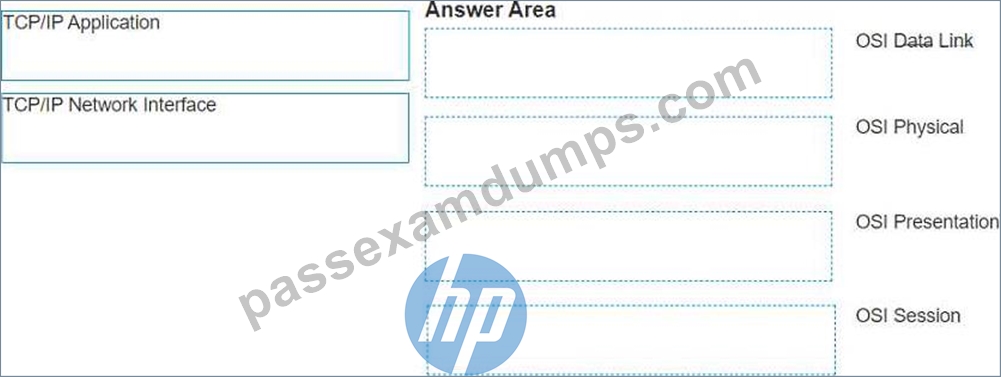
Answer:
Explanation: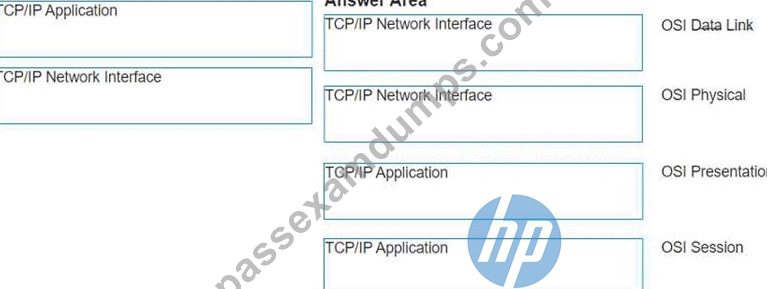
NEW QUESTION # 20
Which server certificate in the chain of trust is self-signed?
- A. Root CA certificate
- B. Intermediate CA certificate
- C. Issuing CA certificate
- D. Subordinate CA certificate
Answer: A
Explanation:
The root CA certificate is self-signed and serves as the trust anchor at the top of the certificate chain.
NEW QUESTION # 21
Match the Aruba Central technology to the appropriate feature. (Matches may be used more than once.)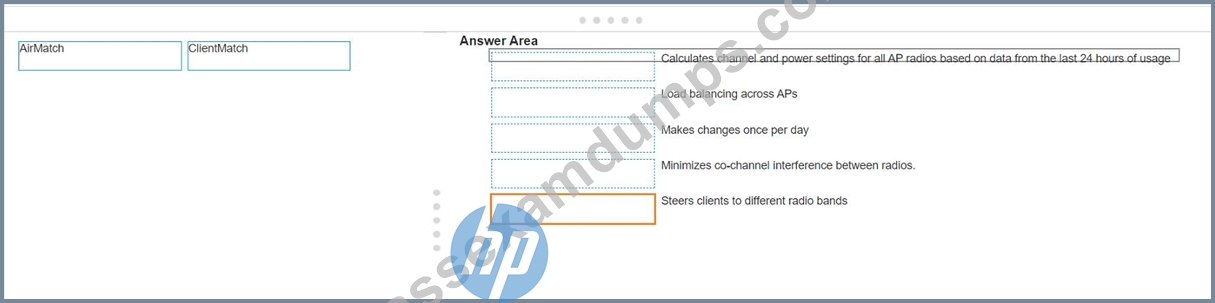
Answer:
Explanation: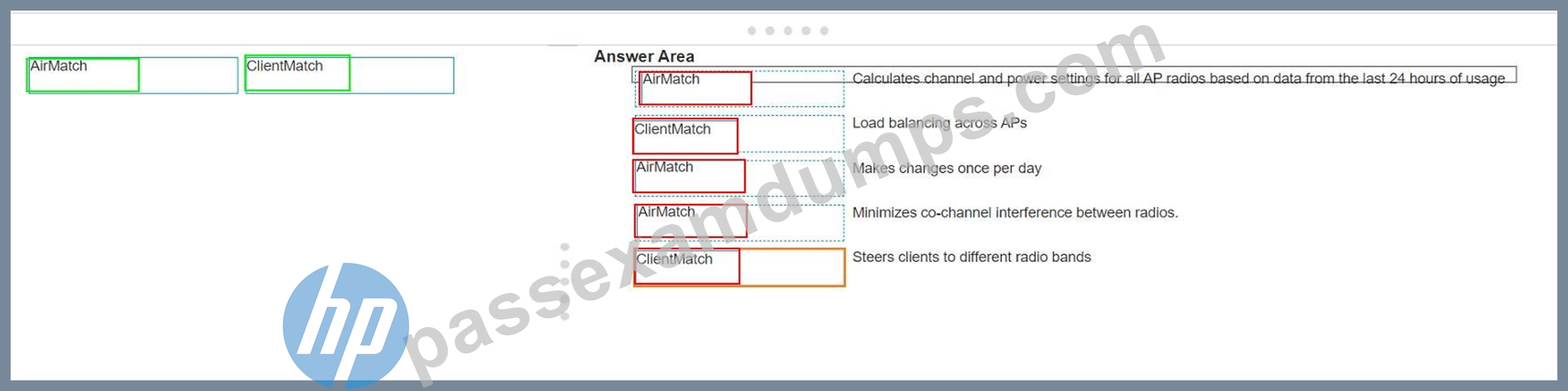
NEW QUESTION # 22
Refer to the exhibit.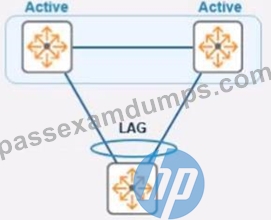
In the given topology, a pair of Aruba CX 8325 switches are in a VSX stack using the active gateway What is the nature and behavior of the Virtual IP for the VSX pair if clients are connected to the access switch using VSX as the default gateway?
- A. Virtual IP is active on the primary VSX switch
Virtual floating IP will failover in case of a failure - B. Virtual IP uses SVI IP address synced with VSX
- C. Virtual IP is active on both CX switches
Answer: A
Explanation:
Explanation
Virtual Switching Extension (VSX) is a feature that allows two Aruba CX switches to operate as a single logical device with a single control plane and data plane. VSX provides high availability, scalability, and simplified management for campus and data center networks3. In VSX, one switch is designated as the primary switch and the other as the secondary switch. The primary switch owns and responds to ARP Address Resolution Protocol. ARP is a communication protocol used for discovering the link layer address, such as a MAC address, associated with a given internet layer address, typically an IPv4 address. This mapping is a critical function in the Internet protocol suite. requests for the virtual IP address of the VSX pair4. The virtual IP address is used as the default gateway for clients connected to the access switch. If the primary switch fails, the secondary switch takes over the virtual IP address and continues to forward traffic for the clients5.
References: 3
https://www.arubanetworks.com/techdocs/AOS-CX_10_04/UG/Content/cx-ug/vsx/vsx-overview.htm 4
https://www.arubanetworks.com/techdocs/AOS-CX_10_04/UG/Content/cx-ug/vsx/vsx-ip-addressing.htm 5
https://www.arubanetworks.com/techdocs/AOS-CX_10_04/UG/Content/cx-ug/vsx/vsx-failover.htm
NEW QUESTION # 23
What does the Aruba role-based access control feature provide?
- A. It provides dynamic firewall rules based on user identity.
- B. It restricts users to specific network segments based on their device type.
- C. It automates the deployment of network devices.
- D. It assigns VLANs to user roles.
Answer: A
NEW QUESTION # 24
What is the correct order of the TCP 3-Way Handshake sequence?
Answer:
Explanation:
Explanation:
TCP 3-Way Handshake sequence is:
* Step 1: The initiating host sends a packet with no data to the target host with a SEQ=1 and sets the SYN flag to 1.
* Step 2: The target host responds with a packet with ACK=2, SEQ=8, and the SYN and ACK flags set to
1.
* Step 3: The initiating host sends a packet with SEQ=2, ACK=9, and the ACK flag set to 1.
* Step 4: A normal-controlled connection is established.
References: https://en.wikipedia.org/wiki/Transmission_Control_Protocol https://www.cisco.com/c/en/us
/support/docs/ip/routing-information-protocol-rip/13788-3.html
NEW QUESTION # 25
Which part of the WPA Key Hierarchy is used to encrypt and/or decrypt data''
- A. number used once (nonce)
- B. Key Confirmation Key (KCK)
- C. Pairwise Temporal Key (PTK)
- D. Pairwise Master Key (PMK)
Answer: C
Explanation:
The part of WPA Key Hierarchy that is used to encrypt and/or decrypt data is Pairwise Temporal Key (PTK). PTK is a key that is derived from PMK Pairwise Master Key (PMK) is a key that is derived from PSK Pre-shared Key (PSK) is a key that is shared between two parties before communication begins, ANonce Authenticator Nonce (ANonce) is a random number generated by an authenticator (a device that controls access to network resources, such as an AP), SNonce Supplicant Nonce (SNonce) is a randomnumber generated by supplicant (a device that wants to access network resources, such as an STA), AA Authenticator Address (AA) is MAC address of authenticator, SA Supplicant Address (SA) is MAC address of supplicant using Pseudo-Random Function (PRF).
PTK consists of four subkeys:
- KCK Key Confirmation Key (KCK) is used for message integrity check
- KEK Key Encryption Key (KEK) is used for encryption key distribution
- TK Temporal Key (TK) is used for data encryption
- MIC Message Integrity Code (MIC) key
The subkey that is specifically used for data encryption is TK Temporal Key (TK). TK is also known as Pairwise Transient Key (PTK). TK changes periodically during communication based on time or number of packets transmitted.
The other options are not part of WPA Key Hierarchy because:
- PMK: PMK is not part of WPA Key Hierarchy, but rather an input for deriving PTK.
- KCK: KCK is part of WPA Key Hierarchy, but it is not used for data encryption, but rather for message integrity check.
- Nonce: Nonce is not part of WPA Key Hierarchy, but rather an input for deriving PTK.
References:
https://en.wikipedia.org/wiki/Wi-Fi_Protected_Access#WPA_key_hierarchy_and_management
https://www.cwnp.com/wp-content/uploads/pdf/WPA2.pdf
NEW QUESTION # 26
Match each AAA service with its correct definition (Matches may be used more than once or not at all)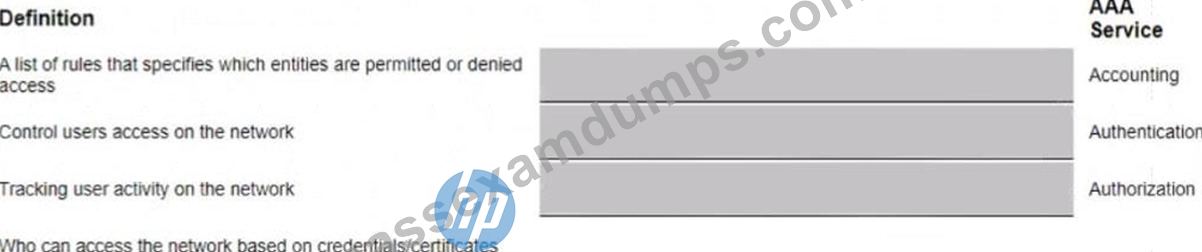
Answer:
Explanation: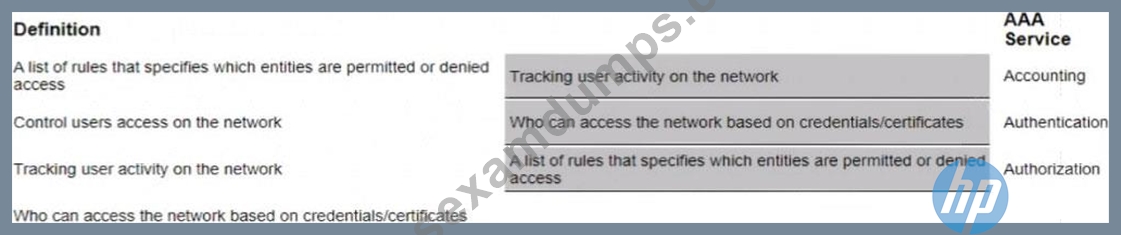
Explanation:
Here are the correct matches for each AAA (Authentication, Authorization, and Accounting) service with its definition:
Accounting: Tracking user activity on the network
Authentication: Who can access the network based on credentials/certificates Authorization: A list of rules that specifies which entities are permitted or denied access Accounting is concerned with keeping a record of user activity, Authentication is the process of verifying identity, and Authorization determines what an authenticated user is allowed to do on the network.
NEW QUESTION # 27
A network technician is using Aruba Central to troubleshoot network issues Which dashboard can be used to view and acknowledge issues when beginning the troubleshooting process?
- A. the Alerts and Events dashboard
- B. the Reports dashboard
- C. the Tools dashboard
- D. the Audit Trail dashboard
Answer: A
Explanation:
The Alerts and Events dashboard displays all types of alerts and events generated for events pertaining to device provisioning, configuration, and user management. You can use the Config icon to configure alerts and notifications for different alert categories and severities1. You can also view the alerts and events in the List view and Summary view2. References: 1 https://www.arubanetworks.com/techdocs/central/latest/content/nms
/alerts/configuring-alerts.htm 2 https://www.arubanetworks.com/techdocs/central/latest/content/nms/alerts
/viewing-alerts.htm
NEW QUESTION # 28
What is indicated by a solid amber radio status LED on an Aruba AP?
- A. Not enough PoE is provided from the switch to power both radios of the AP
- B. The radio is working the 5 GHz band only.
- C. The radio is enabled in monitor or spectrum analysis mode
- D. The radio is working in mesh mode
Answer: A
Explanation:
A solid amber radio status LED on an Aruba Access Point (AP) typically indicates a power issue, specifically that not enough Power over Ethernet (PoE) is being provided from the switch to fully power all functionalities of the AP, including both of its radios. In environments where APs are powered via PoE, it is crucial to ensure that the switch supplying the power is capable of delivering sufficient power for the AP's requirements. If the AP does not receive enough power, it may disable certain features or radios to conserve energy, which is indicated by the solid amber LED. This situation is common in scenarios where the switch provides only 802.3af PoE rather than the more powerful 802.3at PoE+ needed by some high-performance APs to operate all features, including dual radios, at full capacity.
NEW QUESTION # 29
The customer has a requirement to create authorization policies for their users with Windows 10 clients, with a requirement for authorizing both device and user credentials within one Radius session. What would be the correct solution for the requirement?
- A. ClearPass 6.9 with EAP-TLS
- B. ClearPass 6.9 with EAP-TEAP
- C. ClearPass 6.9 with EAP-TTLS
- D. ClearPass 6.9 with PEAP
Answer: B
Explanation:
EAP-TEAP is a tunnel-based authentication method that supports both device and user authentication within a single RADIUS session. ClearPass 6.9 supports EAP-TEAP as anauthentication method for Windows 10 clients.
NEW QUESTION # 30
Where are wireless client roaming decisions made?
- A. Aruba Central
- B. Client device
- C. Joint decision made by the origination and destination APs
- D. Virtual Controller
Answer: B
Explanation:
Wireless client roaming decisions are made by the client device based on its own criteria, such as signal strength, noise level, data rate, etc. The network can influence the client's roaming decision by providing information such as neighbor reports, load balancing, band steering, etc., but the final decision is up to the client.References:https://www.arubanetworks.com/techdocs/Instant_86_WebHelp/Content/instant-ug/wlan- roaming/client-roaming.htm Wireless client roaming decisions are primarily made by the client device itself. The client device monitors the signal strength and quality of the current connection and decides to roam to a different Access Point (AP) when the current signal deteriorates below a certain threshold or a better option is available. While APs and controllers can provide information and support for roaming decisions through protocols like 802.11k and
802.11v, the ultimate decision to roam is made by the client device based on its algorithms and thresholds.
NEW QUESTION # 31
Which device configuration group types can a user define in Aruba Central during group creation?
(Select two.)
- A. ESP group
- B. Template group
- C. Security group
- D. Default group
- E. Ul group
Answer: B,C
Explanation:
In Aruba Central during group creation, users can define various configuration groups to manage settings for multiple devices. A Security group allows you to apply consistent security settings across devices, and a Template group enables you to apply pre-defined configurations to devices. These groups help streamline the deployment and management of network devices in Aruba Central.
NEW QUESTION # 32
The customer has a requirement to create authorization policies for their users with Windows 10 clients, with a requirement Tor authorizing both device and user credentials within one Radius session.
What would be the correct solution for the requirement?
- A. ClearPass 6.9 with EAP-TLS
- B. ClearPass 6.9 with EAP-TEAP
- C. ClearPass 6.9 with EAP-TTLS
- D. ClearPass 6.9 with PEAP
Answer: B
Explanation:
Explanation
EAP-TEAP is a tunnel-based authentication method that supports both device and user authentication within a single RADIUS session. ClearPass 6.9 supports EAP-TEAP as anauthentication method for Windows 10 clients. References:
https://www.arubanetworks.com/techdocs/ClearPass/6.9/Guest/Content/CPPM_UserGuide/EAP-TEAP/EAP-TE
NEW QUESTION # 33
Drag and Drop Question
Match the Open Systems Interconnection (OSI) layer with its function.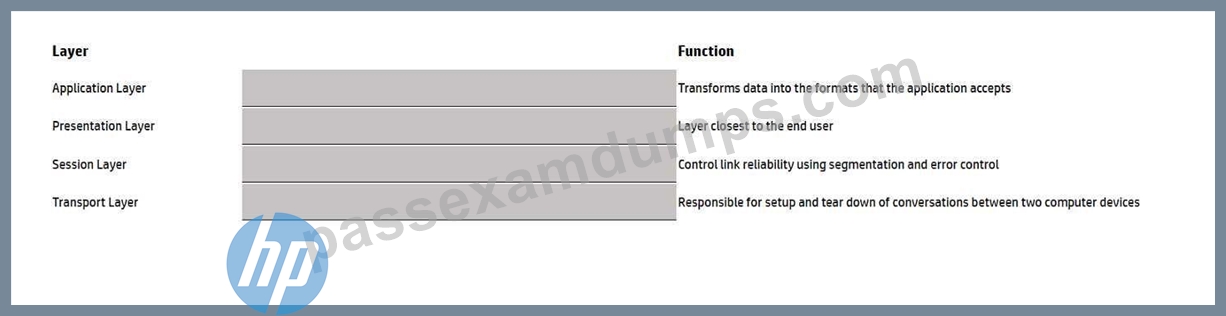
Answer:
Explanation: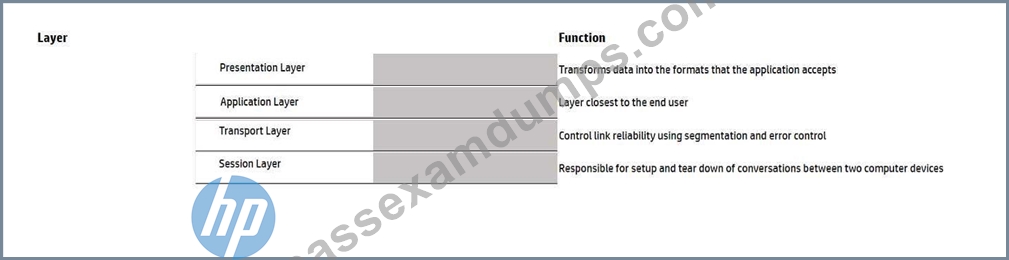
NEW QUESTION # 34
When using the network check page in Central, what kind of tests can you run on switches?
(Select two.)
- A. PoE-check
- B. Speed test (iperf)
- C. LED-check.
- D. A full hardware check, including a heavy memory check
- E. Ping test
Answer: A,E
Explanation:
In Aruba Central's network check page, you can run several diagnostic tests on switches. A ping test is a common utility to check the reachability of a host on an IP network. A Power over Ethernet (PoE) check can help verify the power delivery status to PoE-capable devices. These tests are crucial for ensuring connectivity and power supply to network devices
NEW QUESTION # 35
......
Certification dumps ACA Campus Access Associate HPE6-A85 guides - 100% valid: https://www.passexamdumps.com/HPE6-A85-valid-exam-dumps.html
100% Pass Your HPE6-A85 Aruba Certified Campus Access Associate Exam at First Attempt with PassExamDumps: https://drive.google.com/open?id=1WKwHExFpLxJMy5o53UwherjGqtXAmm-4
