

Cloud-Digital-Leader Questions Pass on Your First Attempt Dumps for Google Cloud Certified Certified
Cloud-Digital-Leader Practice Test Pdf Exam Material
Who needs to take Google Cloud Digital Leader Exam?
There are a variety of opportunities for students who are willing to take up the challenge that the digital economy presents. To make sure that students remain sharp and in tune with the latest technological developments, Google has recently announced its certification program for cloud solutions. The Cloud Digital Leader (CDL) certification is designed to test and certify the skills of IT professionals in cloud computing solutions. Google Cloud Digital Leader Dumps are written to the highest standards of technical accuracy, provided by our certified subject-matter experts and published authors for development.
In addition to the CDL certification, there are other certifications like Google Certified Professional Developer, Google Certified System Administrator, Google Certified Big Data Engineer, and Google Certified Solutions Architect. Those who have successfully passed the exam will have their names listed on GCP's Certification Register and earn a digital badge on their public profiles on GCP Marketplace. Lift the covers on features like Cloud Spanner and Datastore.
NEW QUESTION 91
What service is a fully managed real-time messaging service that allows you to send and receive messages between independent applications.
- A. Cloud BigTable
- B. Cloud Pub/Sub
- C. Cloud DNS
- D. Cloud Datastore
- E. Cloud Spanner
Answer: B
Explanation:
Google Cloud Pub/Sub is a scalable, durable event ingestion and delivery system.
-> Pub/Sub allows services to communicate asynchronously, with latencies on the order of 100 milliseconds.
-> Pub/Sub is used for streaming analytics and data integration pipelines to ingest and distribute data. It is equally effective as messaging-oriented middleware for service integration or as a queue to parallelize tasks.
-> Pub/Sub enables you to create systems of event producers and consumers, called publishers and subscribers. Publishers communicate with subscribers asynchronously by broadcasting events, rather than by synchronous remote procedure calls (RPCs).
Reference link- https://cloud.google.com/pubsub/docs/overview
NEW QUESTION 92
Cloud SQL is a fully-managed relational database service for MySQL, PostgreSQL and SQL serv-ers, keeping Cloud SQL Google Cloud Service in mind, which of the following statements is/are correct?
- A. With DMS (Database Migration Service) it becomes very easy to Migration of Pro-duction Database.
- B. Data inside cloud SQL is automatically Encrypted.
- C. Cloud SQL automatically ensures your databases are reliable, secure, and scala-ble so that your business continues to run without disruption.
- D. All of the above
Answer: D
Explanation:
Cloud SQL
Fully managed relational database service for MySQL, PostgreSQL, and SQL Server. Run the exact same relational databases you know with their rich extension collections, configuration flags and developer ecosystem, but without the hassle of self management.
- Reduce maintenance cost with fully managed MySQL, PostgreSQL and SQL Server databases.
- Ensure business continuity with reliable and secure services backed by 24/7 SRE team.
- Automate database provisioning, storage capacity management, and other time-consuming tasks.
- Database observability made easy for developers with Cloud SQL Insights.
- Easy integration with existing apps and Google Cloud services like GKE and BigQuery.
Key features:
Fully managed
Cloud SQL automatically ensures your databases are reliable, secure, and scalable so that your business continues to run without disruption. Cloud SQL automates all your backups, replication, encryption patches, and capacity increases-while ensuring greater than 99.95% availability, anywhere in the world.
Integrated
Access Cloud SQL instances from just about any application. Easily connect from App Engine, Compute Engine, Google Kubernetes Engine, and your workstation. Open up analytics possibilities by using BigQuery to directly query your Cloud SQL databases.
Reliable
Easily configure replication and backups to protect your data. Go further by enabling automatic failover to make your database highly available. Your data is automatically encrypted, and Cloud SQL is SSAE 16, ISO 27001, and PCI DSS compliant and supports HIPAA compliance.
Easy migrations to Cloud SQL
Database Migration Service (DMS) makes it easy to migrate your production databases to Cloud SQL with minimal downtime. This serverless offering eliminates the manual hassle of provisioning, managing, and monitoring migration-specific resources. DMS leverages the native replication capabilities of MySQL and PostgreSQL to maximize the fidelity and reliability of your migration. And it's available at no additional charge for native like-to-like migrations to Cloud SQL.
NEW QUESTION 93
Your organization runs all its workloads on Compute Engine virtual machine instances. Your organization has a security requirement: the virtual machines are not allowed to access the public internet. The workloads running on those virtual machines need to access BigQuery and Cloud Storage, using their publicly accessible interfaces, without violating the security requirement.
Which Google Cloud product or feature should your organization use?
- A. Identity-Aware Proxy
- B. Private Google Access
- C. Cloud NAT (network address translation)
- D. VPC internal load balancers
Answer: B
Explanation:
VM instances that only have internal IP addresses (no external IP addresses) can use Private Google Access. They can reach the external IP addresses of Google APIs and services. The source IP address of the packet can be the primary internal IP address of the network interface or an address in an alias IP range that is assigned to the interface. If you disable Private Google Access, the VM instances can no longer reach Google APIs and services; they can only send traffic within the VPC network.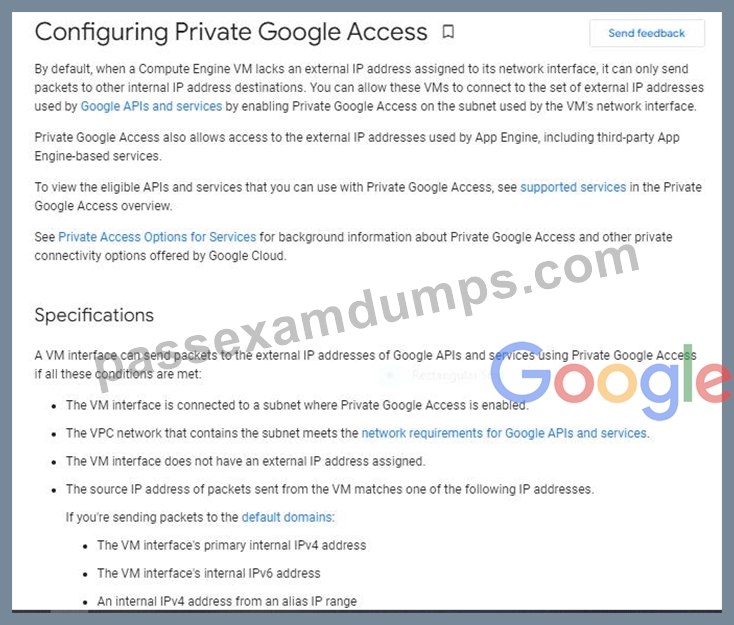
https://cloud.google.com/vpc/docs/configure-private-google-access
NEW QUESTION 94
You are working with a user to set up an application in a new VPC behind a firewall and it is no-ticed that the user is concerned about data egress. Therefore, to provide assistance you want to con-figure the fewest open egress ports. Which of the following statement is correct?
- A. Set up a high-priority (1000) rule that blocks all egress and a low-priority (65534) rule that allows only the appropriate ports.
- B. Set up a high-priority (1000) rule to allow the appropriate ports.
- C. Set up a high-priority (1000) rule that pairs both ingress and egress ports.
- D. Set up a low-priority (65534) rule that blocks all egress and a high-priority rule (1000) that allows only the appropriate ports.
Answer: D
Explanation:
Implied rules Every VPC network has two implied firewall rules. These rules exist, but are not shown in the Cloud Console:
Implied allow egress rule. An egress rule whose action is allow, destination is 0.0.0.0/0, and priority is the lowest possible (65535) lets any instance send traffic to any destination, except for traffic blocked by Google Cloud. A higher priority firewall rule may restrict outbound access. Internet access is allowed if no other firewall rules deny outbound traffic and if the instance has an external IP address or uses a Cloud NAT instance. For more information, see Internet access requirements.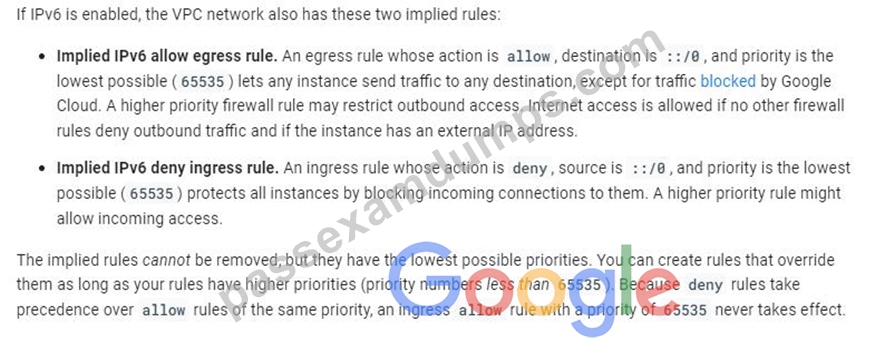
Reference link- https://cloud.google.com/vpc/docs/firewalls
NEW QUESTION 95
Your organization needs to ensure that the Google Cloud resources of each of your departments are segregated from one another. Each department has several environments of its own: development, testing, and production. Which strategy should your organization choose?
- A. Create a Cloud Identity domain per environment, and create a project per department in each domain.
- B. Create a Cloud Identity domain per department, and create a project per environment in each domain.
- C. Create a project per department, and create a folder per environment in each project.
- D. Create a folder per department, and create a project per environment in each folder.
Answer: A
NEW QUESTION 96
How should a multinational organization that is migrating to Google Cloud consider security and privacy regulations to ensure that it is in compliance with global standards?
- A. Comply with international standards for data security and privacy, because they supersede all regional regulations
- B. Comply with data security and privacy regulations in each geographical region
- C. Comply with regional standards for data security and privacy, because they supersede all international regulations
- D. Comply with regional data security regulations, because they're more complex than privacy standards
Answer: A
NEW QUESTION 97
You are a cloud architect in a software solution provider company, one of the client that is a Na-tional Bank who wants to build an application that deals with transactions processing, and it needs a relational database with petabyte of scale dat a. Which of the following Google Cloud Services will you use?
- A. Cloud Spanner
- B. Cloud Bigtable
- C. Google Cloud BigQuery
- D. Cloud SQL
Answer: A
Explanation:
- Cloud Spanner is the online transaction processing solution that is relational and offers petabyte scalability. Cloud SQL is not designed for petabyte-scale data.
NEW QUESTION 98
Your organization needs to build streaming data pipelines. You don't want to manage the individual servers that do the data processing in the pipelines. Instead, you want a managed service that will automatically scale with the amount of data to be processed.
Which Google Cloud product or feature should your organization choose?
- A. Dataprep by Trifacta
- B. Data Catalog
- C. Dataflow
- D. Pub/Sub
Answer: C
Explanation:
Reference: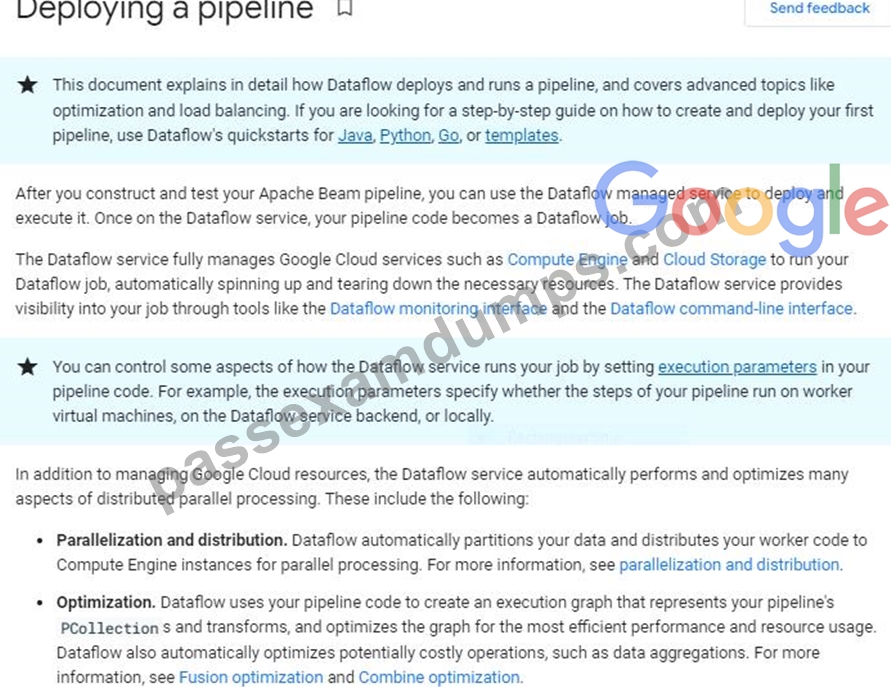
Reference link- https://cloud.google.com/dataflow/docs/guides/deploying-a-pipeline
NEW QUESTION 99
Which of the followings are core components of Anthos?
- A. Secure software supply chain
- B. All of the above are correct.
- C. Multicluster & Configuration management
- D. Infrastructure, container, and cluster management
Answer: B
Explanation: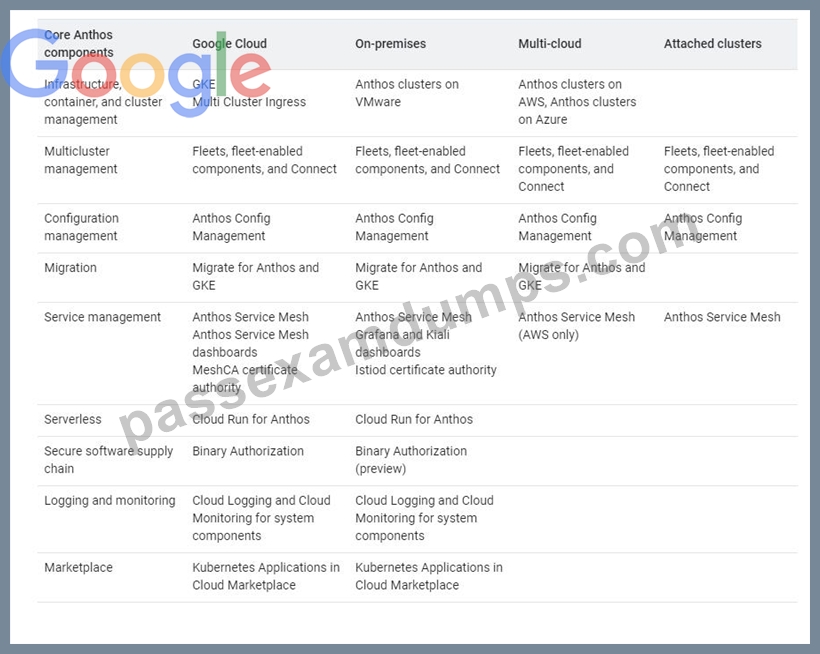
NEW QUESTION 100
The government has mandated that companies in a particular section of healthcare must retain all the data they collect for a period of 10 years in case an audit needs to be done. Your client, who is in that industry, needs to follow regulations. In addition, your client wants to do an analysis of the data quite frequently in the first year. They also don't want to be liable for any data beyond year 10. What would recommend for your customer?
- A. Use Cloud Storage with standard storage in year one and archival storage thereaf-ter. Use Object lifecycle management to move between storage types and delete them after 10 years.
- B. Use Cloud Storage with standard storage in year one and Coldline storage there-after. Set a Cloud Tasks to trigger for 1 year to change storage types and 10 years to delete the data.
- C. Use Cloud Storage with standard storage in year one and Coldline storage there-after. Set a Cloud Scheduler trigger for 1 year to change storage types and 10 years to delete the data.
- D. Use Cloud Storage with nearline storage in year one and Coldline storage thereaf-ter. Use Object lifecycle management to move between storage types and delete them after 10 years.
Answer: A
Explanation:
Cloud storage supports Object Lifecycle Management. To support common use cases like setting a Time to Live (TTL) for objects, retaining noncurrent versions of objects, or "downgrading" storage classes of objects to help manage costs, Cloud Storage offers the Object Lifecycle Management feature.
Standard storage is recommended for frequently accessed data and Archive for data accessed less than once a year.
Nearline, Coldline, and Archive offer ultra-low-cost, highly-durable, highly available archival storage. For data accessed less than once a year, Archive is a cost-effective storage option for the long-term preservation of data. Coldline is also ideal for cold storage-data your business expects to touch less than once a quarter. For warmer storage, choose Nearline: data you expect to access less than once a month, but possibly multiple times throughout the year.
NEW QUESTION 101
A startup client of yours does offline data processing for a few of its clients. They are mi-grating their applications and the associated data to Google Cloud. They have 100TB of data to move. They presently have a very small private data center setup connected to a local internet provider. The maximum bandwidth they are able to get is 100Mbps. How long will it take them to transfer the data over the internet if the transfer goes smoothly?
- A. About 100 days.
- B. About 2 years.
- C. About 24 hours.
- D. bout 12 days.
Answer: A
Explanation:
The key reason I included this question is to clarify some terminologies that will be important for your estimates. The data size mentioned is a TB terabyte. Note the "byte". The speed is mentioned in Mbps, which is Megabits per second. Note the "bits". 8 bits make a byte. So, to get the actual number of bits transferred, you need to multiply the TB number by 8.
Total data transferred (in bits) = 100 * 1,000,000,000,000 * 8 bits
Speed = 100Mbps = 100 * 1,000,000. i.e. 100 million bits are transferred per second.
Hence time taken to transfer all the data = Total Data/Speed = 8,000,000 seconds.
Number of seconds in a day = 24*60*60 = 86,400
Total time taken in days = 8,000,000/86,400 = 92.59 days
Reference link- https://cloud.google.com/architecture/migration-to-google-cloud-transferring-your-large-datasets#online_versus_offline_transfer
NEW QUESTION 102
Which of the following statements is/are correct about Bare Metal Solutions?
- A. All of the Above.
- B. The network, which Google Cloud manages includes a low-latency Cloud Inter-connect connection into the customer Bare Metal Solution environment.
- C. Bare Metal Solution uses a bring-your-own-license (BYOL) model.
- D. Bare Metal Solution also includes the provisioning and maintenance of the cus-tom, sole-tenancy hardware with local SAN, and smart hands support.
Answer: A
Explanation:
Option A is true
You are responsible for the licensing of all of your software. Bare Metal Solution uses a bring-your-own-license (BYOL) model.
Apart from this you are responsible for the software, applications, and data that you use and store in the Bare Metal Solution environment.
Responsibilities
Data, including:
- Security and encryption
- Backups
Software and applications, including:
- Installation
- Configuration
- Upgrades and patching
Operating system and any hypervisor, including:
- Configuration changes
- Upgrades and patching
Server clusters, including:
- Installation
- Configuration
- Maintenance
Licensing
Option B & C is also true.
With Bare Metal Solution, Google Cloud provides and manages the core infrastructure, the net-work, the physical and network security, and hardware monitoring capabilities in an environment from which you can access all of the Google Cloud services. The core infrastructure includes secure, controlled-environment facilities, and power.
The Bare Metal Solution also includes the provisioning and maintenance of the custom, sole-tenancy hardware with local SAN, and smart hands support.
The network, which is managed by Google Cloud includes a low-latency Cloud Interconnect con-nection into the customer Bare Metal Solution environment.
The available Google Cloud services include private API access, management tools, support, and billing.
NEW QUESTION 103
Your organization needs a large amount of extra computing power within the next two weeks.
After those two weeks, the need for the additional resources will end.
Which is the most cost-effective approach?
- A. Use a committed use discount to reserve a very powerful virtual machine
- B. Purchase multiple physical computers and scale workload across them
- C. Start a very powerful virtual machine without using a committed use discount
- D. Purchase one very powerful physical computer
Answer: C
Explanation:
When you purchase a committed use contract, you purchase Compute Engine resources-such as vCPUs, memory, GPUs, local SSDs, and sole-tenant nodes-at a discounted price in return for committing to paying for those resources for 1 year or 3 years
NEW QUESTION 104
Your application has repeated data requests of the exact same nature. At the same time, the number of user requests is increasing. Monitoring indicates that the load on the existing database is increasing, and there seems to be a bottleneck. An analysis of the data requested shows us that it is application-managed data and that it changes, but not often. How can you improve the efficiency of the application?
- A. Increase the number of CPUs on the machine hosting the database so that it has higher data throughput.
- B. Use Cloud Memorystore to improve speed via caching
- C. Increase the amount of RAM on the machine hosting the database so that it has higher data throughput.
- D. Use Cloud Storage with multi-regional storage so that all users accessing the data will have lower latency
Answer: B
Explanation:
Cloud Memorystore is an in-memory database that has sub-millisecond latency. This is ideal for caching application data that also changes once in a while.
https://cloud.google.com/memorystore
NEW QUESTION 105
Virtual Machine vCPU and memory usage for each of these categories can receive one of the following discounts? (Select Three Answer)
- A. Sustained-Use
- B. Committed-Use
- C. Preemptible VMs
- D. Spot Instances
- E. Military Discounts
Answer: A,B,C
Explanation:
Sustained, Committed and Preemptible
vCPU and memory usage for each of these categories can receive discounts VM vCPU and memory usage for each of these categories can receive discounts Sustained-use discounts-Google offers up to 30% off for workloads that run for most of the billing month on GCP services.
Committed-use discounts-users can save up to 57% by committing to use an instance for a certain time period, with no upfront payment and with the flexibility to change instances during the commitment period.
Preemptible VMs-similar to the concept of AWS spot instances, Google offers up to 79% off for Virtual Machines that may be shut down at any time and replaced by others.
Reference link- https://cloud.google.com/compute/docs/sustained-use-discounts Reference link- https://cloud.google.com/compute/docs/instances/signing-up-committed-use-discounts Reference link- https://cloud.google.com/compute/docs/instances/preemptible
NEW QUESTION 106
One of your clients is in the retail sector. They have a small team supporting their operations and a small development team taking care of application development. They have heard of the benefits of machine learning, but they do not have the capacity to hire data scientists or the work to retain them. They have a team of analysts who works primarily on BigQuery and knows how to run SQL queries. They want to be able to get into the new age of machine learning and artificial intelligence. What options are available to run on Google Cloud?
- A. Use the Unified AI Platform to create a custom TensorFlow model.
- B. Integrate the Cloud Vision API and the Cloud Speech API to create a custom mod-el that will suit the retail sector.
- C. Use the popular open-source libraries SciPy and NumPy to create machine learn-ing models.
- D. Use BigQuery ML to create machine learning models using SQL queries.
Answer: D
Explanation:
BigQuery ML allows you to create ML models using standard SQL queries. Those familiar with BigQuery and ML will be able to create ML models with just a basic understanding of machine learning.
https://cloud.google.com/bigquery-ml/docs/
NEW QUESTION 107
How does a least privilege resource access model contribute to cloud security?
- A. Only managers and other senior employees have cloud resource access.
- B. Google is responsible for determining access to cloud resources.
- C. Employees may only access on-premises software with special permission.
- D. Employees only have access to the cloud resources necessary for their job.
Answer: D
Explanation:
This is the definition of a least privilege model.
A supporting principle that helps organizations achieve these goals is the principle of least privilege. The principle of least privilege addresses access control and states that an individual should have only the minimum access privileges necessary to perform a specific job or task and nothing more
NEW QUESTION 108
What conditions be true if a VM interface wants to send packets to the external IP addresses of Google APIs and services using Private Google Access?
- A. VM interface is connected to a subnet where Private Google Access is disabled
- B. None of the Above.
- C. Both A and B
- D. VM interface does not have an external IP address assigned.
Answer: D
Explanation:
A VM interface can send packets to the external IP addresses of Google APIs and services using Private Google Access if all these conditions are met:
- The VM interface is connected to a subnet where Private Google Access is enabled.
- The VPC network that contains the subnet meets the network requirements for Google APIs and services.
- The VM interface does not have an external IP address assigned.
- The source IP address of packets sent from the VM matches the VM interface's primary internal IP address or an internal IP address from an alias IP range.
A VM with an external IP address assigned to its network interface doesn't need Private Google Access to connect to Google APIs and services. However, the VPC network must meet the requirements for accessing Google APIs and services.
NEW QUESTION 109
You are leading projects in an IT services company. Your customer's project requires analyzing im-ages. They have many 10s of 1000s of raw images that they have made available to you. Your small technology team needs to build a machine learning model. The images are unlabeled. You don't have the people or the capacity to label the images. What is your approach?
- A. Hire temporary workers who can quickly label the images.
- B. Tell the customer it is their duty to label the images.
- C. Request data labeling service from Google.
- D. Look for open-source labeled images that closely resemble the given images.
Answer: B
Explanation:
Google's Data Labeling Service lets you work with human labelers to generate highly accurate labels for a collection of data that you can use in machine learning models.
References:
-> https://cloud.google.com/vertex-ai/docs/datasets/data-labeling-job
-> https://cloud.google.com/ai-platform/data-labeling/docs
NEW QUESTION 110
When you update the function in firebase by deploying updated code, instances for older versions are cleaned up along with build artifacts in __________________ and replaced by new instances.
- A. Container Registry repository.
- B. None of the Above
- C. Storage and Container Registry.
- D. Google Cloud console.
Answer: C
Explanation:
Container Registry is a single place for your team to manage Docker images, perform vulnerability analysis, and decide who can access what with fine-grained access control
NEW QUESTION 111
What are the network requirements for Private Google Access?
- A. Both A and B
- B. Your network must have appropriate routes for the destination IP ranges used by Google APIs and services.
- C. None of the Above
- D. Private Google Access automatically enables any API.
Answer: B
Explanation:
Network requirements for Private Google Access:
- Because Private Google Access is enabled on a per-subnet basis, you must use a VPC network. Legacy networks are not supported because they don't support subnets.
- Private Google Access does not automatically enable any API. You must separately enable the Google APIs you need to use via the APIs & services page in the Google Cloud Console.
- If you use the private.googleapis.com or the restricted.googleapis.com domain names, you'll need to create DNS records to direct traffic to the IP addresses associated with those domains.
- Your network must have appropriate routes for the destination IP ranges used by Google APIs and services. These routes must use the default internet gateway next hop. If you use the private.googleapis.com or the restricted.googleapis.com domain names, you only need one route (per domain). Otherwise, you'll need to create multiple routes.
- Egress firewalls must permit traffic to the IP address ranges used by Google APIs and services. The implied allow egress firewall rule satisfies this requirement. For other ways to meet the firewall requirement.
NEW QUESTION 112
Your organization recently migrated its compute workloads to Google Cloud. You want these workloads in Google Cloud to privately and securely access your large volume of on-premises data, and you also want to minimize latency.
What should your organization do?
- A. Peer your on-premises data center to Google's Edge Network
- B. Use Transfer Appliance to securely make your data available to Google Cloud
- C. Use Storage Transfer Service to securely make your data available to Google Cloud
- D. Create a VPC between your on-premises data center and your Google resources
Answer: D
NEW QUESTION 113
Your organization runs all its workloads on Compute Engine virtual machine instances. Your organization has a security requirement: the virtual machines are not allowed to access the public internet. The workloads running on those virtual machines need to access BigQuery and Cloud Storage, using their publicly accessible interfaces, without violating the security requirement.
Which Google Cloud product or feature should your organization use?
- A. Identity-Aware Proxy
- B. Private Google Access
- C. Cloud NAT (network address translation)
- D. VPC internal load balancers
Answer: C
NEW QUESTION 114
A large travel company has thus far invested heavily in their technology team. There is strategic pressure on the company to focus on their core business and innovate to survive in certain geogra-phies and thrive in others. They are evaluating whether a move to Google Cloud will be good for them. Which of these reasons would be relevant for them? (choose two answer)
- A. Budgeting won't be an issue since the cloud takes care of billing.
- B. Application architecture won't be too involved because of serverless options.
- C. The IT team won't have to work on procuring and provisioning new hardware and refreshes to existing hardware.
- D. The IT team won't have to manage software upgrades, security patches, etc. for the VMs.
Answer: C,D
NEW QUESTION 115
......
The Fundamentals of Google Cloud Digital Leader Certification
The Google Cloud Digital Leader Certification gives you the confidence you need to face today's most complex technology problems with ease. The Google Cloud Digital Leader Certification is an advanced level of certification that assures you're at the forefront of digital transformation with your enterprise IT environment. The Google Cloud Digital Leader Certification proves that you're able to solve some of the most complex problems with ease using the latest and most innovative tools available these types of questions are also covered in our Cloud Digital Leader Dumps. Resource compute is the options to explain in detail what exactly is the difficulty for your work. Model flexibility management is an option that can be used to show the risks involved in the work. Paid webpages are the serverless database at the center that is important for your business.
The Google Cloud Digital Leader Certification shows your bosses, colleagues, and clients that you have what it takes to be a success in this role. The Google Cloud Digital Leader Certification shows that are committed to providing your customers with exceptional cloud solutions and support. The Google Cloud Digital Leader Certification shows that you have the skills needed to deliver high-quality IT solutions for your company's business units and customers.
Cloud-Digital-Leader [Nov-2022] Newly Released] Exam Questions For You To Pass: https://www.passexamdumps.com/Cloud-Digital-Leader-valid-exam-dumps.html
Cloud-Digital-Leader Answers Cloud-Digital-Leader Free Demo Are Based On The Real Exam: https://drive.google.com/open?id=1EffFK8oBUoHYbrtvKrciEyXclt95NgGE
