

1Z0-1062-20 Certification - The Ultimate Guide [Updated 2021]
1Z0-1062-20 Practice Exam and Study Guides - Verified By PassExamDumps
Oracle 1Z0-1062-20 Exam Syllabus Topics:
| Topic | Details |
|---|---|
| Topic 1 |
|
| Topic 2 |
|
| Topic 3 |
|
| Topic 4 |
|
| Topic 5 |
|
| Topic 6 |
|
| Topic 7 |
|
| Topic 8 |
|
| Topic 9 |
|
| Topic 10 |
|
| Topic 11 |
|
| Topic 12 |
|
| Topic 13 |
|
| Topic 14 |
|
| Topic 15 |
|
| Topic 16 |
|
NEW QUESTION 39
Your client is tuning four performance measures with the same output expression 'SUM (Credit.Credit Amount)' and no scorecard. The following transactions were processed through the performance measure.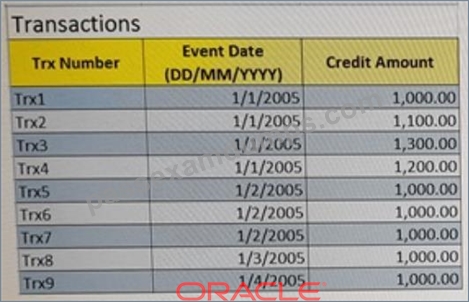
On examining closely, you found that though performance measure has the same output expression, the output (refer below) for the performance measure is not equal.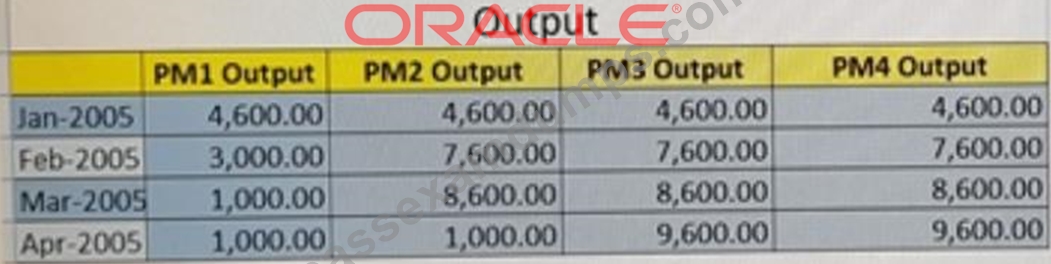
Which performance measure attribute is responsible for this variation?
- A. Performance Interval
- B. Unit of Measure
- C. Distribute By
- D. Process Transactions
Answer: B
NEW QUESTION 40
Which three statements are true regarding Classification?
- A. Rule criteria involve one or more transaction attributes.
- B. Classification splits the credits among the participant credit receivers.
- C. Classification rules are used to classify transactions into meaningful credit categories.
- D. Qualifiers are ANDed and qualifier attribute values are ORed.
- E. Classification process must be run before the Crediting process.
Answer: A,D,E
NEW QUESTION 41
Which are the three broad categories, based on which cross subject area reporting can be built?
- A. using common dimensions
- B. combining logical SQL using the Advanced tab
- C. combining more than one result set from different subject areas by using set operators such as Union, union all, Intersection, Cartesian, and Difference
- D. using common and local dimensions
Answer: A,C,D
Explanation:
Explanation
Cross-Subject Area Analyses: Explained
You can create analyses that combine data from more than one subject area. This type of query is referred to as a cross-subject area analysis. Cross-subject area analyses can be classified into three broad categories:
* Using common dimensions
* Using common and local dimensions
* Combining more than one result set from different subject areas using set operators such as union, union all, intersection and difference
NEW QUESTION 42
Which format must the date column value have In File Based Data Import?
- A. MM/DD/YYYY
- B. DD/MM/YYYY
- C. YYYY/MM/DD
- D. Date format is configurable
Answer: D
Explanation:
Explanation
https://docs.oracle.com/cloud/farel11/salescs_gs/OAFDI/OAFDI1504155.htm#OAFDI309164
NEW QUESTION 43
A performance measure is set up to determine the commission rate by using total sales attainment percentage tot a quarter, which is measured as total sales by participant for the quarter divided by target for the quarter.
How should you set up this performance measure?
- A. Set Process Transaction = Grouped by Interval and Interval - Quarter, have the input expression 'sum (Credit.transactlonamount/Measure.Target)' and enter targets in the plan component associated with the performance measure.
- B. Set Process Transaction = Individually and Interval - Quarter, select Running Total, select Accumulate for input expression 'credit transaction amount', and enter targets in the plan component associated with the performance measure.
- C. Set Process Transaction = Grouped by Interval and Interval = Quarter, have the input expression 'sum (Oedit.transactionamount/Measure.Target)' and enter targets directly in the performance measure.
- D. Set Process Transaction = Individually and Interval = Quarter, select Running Total, select Accumulate for input expression 'transaction amount', and enter targets directly in the performance measure.
Answer: B
NEW QUESTION 44
In which section of the Home screen do users receive notifications generated by the Approvals functionality?
- A. Worklist: Notifications and Approvals
- B. Approval Manager
- C. Activity Stream
- D. BPM Worklist
Answer: A
NEW QUESTION 45
A client wants to associate both monthly and quarterly calendars with an incentive compensation business unit. Which method do you use to set up multiple calendars for incentive compensation business units?
- A. Go to the Manage Calendars task in the Define Incentive Compensation Shared Configuration task list and associate the same business unit with both calendars.
- B. Go to the Manage Parameters task in the Define Incentive Compensation Business Unit Configuration task list and select a calendar; only one calendar can be selected.
- C. Go to the Manage Parameters task in the Define Incentive Compensation Business Unit Configuration task list and select both calendars.
- D. Go to the Manage Calendars in the Define Incentive Compensation Shared Configuration task list and associate the business unit with a desired period type.
Answer: A
NEW QUESTION 46
Of what type of role is Incentive Compensation Analyst an example?
- A. Duty
- B. Work Area
- C. Job
- D. Abstract
Answer: C
Explanation:
Explanation
Job roles and abstract roles inherit duty roles. For example, the Incentive Compensation Analyst job role inherits the Incentive Compensation Participant Assignments Duty, Incentive Compensation Credits and Earnings Duty, Incentive Compensation Participant Snapshot Management Duty, and the Incentive Compensation Payments Duty. The Compensation Participant Assignments Duty makes it possible for the analyst to assign plans, roles, pay groups, and payment plans to the participant. The Incentive Compensation Payments Duty enables payment batch assembly and paysheet management.
NEW QUESTION 47
The 'Run Crediting and Rollup' process request completes successfully but no credits are created. Which three configurations must be verified?
- A. 'Enable Direct Crediting* is set to 'Yes' on the 'Manage Parameters' page.
- B. Participants assigned to a direct credit rule do not have the Manager role.
- C. The same participants are not assigned to multiple credit rules in the hierarchy.
- D. The transaction event date falls between the credit rule start and end dates.
- E. The 'Deploy Compensation Plans' process was run after the credit rules were created.
- F. The 'Deploy Credit Rule' process was run after the credit rules were created.
Answer: B,C,E
NEW QUESTION 48
The status of the ESS (Enterprise Scheduler Service) request is 'Succeeded.' But the transaction is not credited, and the status of the transaction is not 'Credited.' Which statement is the most complete and gives a correct list of settings and actions that are needed for a transaction to generate valid credits?
- A. Answer A plus-If the 'Enable Classification' parameter is set to 'Yes' and 'Classify Transactions' Is set to 'After collection and before crediting/ then ensure classifying the transactions before running crediting.
- B. Answer B plus-You must run Deploy Credit Rules for the correct date range.
- C. The 'Enable Direct Crediting' parameter is set to "Yes* and the credit rules have valid attributes.
Attribute values and a credit receiver are assigned. - D. Answer B plus-You must set 'Enable Rollup' to 'Yes1 and select 'Rollup in Credit Hierarchy.
- E. Answer B plus-You must assign the correct credit category to the performance measure.
Answer: C
NEW QUESTION 49
Which option will never have access to the full Business Unit?
- A. the Compensation Analyst
- B. the Participant
- C. the Compensation Manager
- D. the Sales Manager and the Participant
- E. the Compensation Analyst and the Participant
Answer: B
NEW QUESTION 50
A business unit has set up a calendar based on fiscal months, but period data is not displaying on reports Select the configuration you must verify to identify the root cause.
- A. Start and end dates for the fiscal months are valid.
- B. Report to work area mapping is defined for each period.
- C. 'Display period data in participant reports' is selected.
- D. Status is set to 'Active' for all of the required months.
Answer: A
NEW QUESTION 51
Your configurations and reports are moved to the Production environment. You want to copy thorn to your Test environment. When should you schedule P2T?
- A. once Production and Test are aligned on the same patch
- B. after the next patch is applied to Test
- C. after the next patch is applied to Production
- D. when P2T tasks are set up In FSM
Answer: D
NEW QUESTION 52
A client wants to reward the Sales Operation team members with one reward point for every dollar of revenue for the last quarter of a fiscal year identify the three steps that the incentive compensation application administrator must take to set up this requirement before associating the reward with a plan component. In this case, the fiscal year corresponds to the calendar year.
- A. Go to the Manage Earning Types task and define a new earning type, such as 'Point Rewards'.
- B. Add a new row to the Conversion Factor section for the earning type 'Point Rewards'
- C. Select the earning type to 'Monetary Earnings', define a conversion factor = 1, and define Start Date =
01-Oct and End Date - 31 Dec for the fiscal year. - D. Set the conversion factor to 1, and define Start Date = 01 Oct and End Date = 31-Dec for the fiscal year.
- E. Set the conversion factor = 0.1, and define Start Date - 01-Oct and End Date = 31-Dec for the fiscal year.
Answer: A
NEW QUESTION 53
Which statement is true about classification rules and credit categories?
- A. You can define the split credit percentage at classification rule UI.
- B. You can associate only one credit category to a classification rule.
- C. You can associate multiple credit categories to a classification rule.
- D. You can associate classification rule to credit category via performance measure.
Answer: C
NEW QUESTION 54
Dining the Rollup process, the Incentive Compensation application determines all participants who must receive indirect credit for the transaction.
Identify the two options this is based on.
- A. Rollup hierarchy effective for that date
- B. Rollup date
- C. all the participants in the organization
- D. all the participants in the compensation group
- E. all the participants associated with that customer
Answer: A,B
Explanation:
Explanation
https://docs.oracle.com/cloud/farel8/salescs_gs/FACMI/F1071275AN2125B.htm
NEW QUESTION 55
You have to write a custom function that accesses the performance measure output.
You must pass the following parameters to uniquely identify data and do custom calculations.
plan_cooponent_id
formaula_id
Participant_id
Period id
In which table should you configure the required columns?
- A. CW_TP_EARNINGS_ALL
- B. CN SRP_PER_FORM_METRICS_ALL
- C. CM SRP PARTICIPANTS ALL
- D. CN TP KEASURE_RESULTS_ALL
Answer: B
Explanation:
Explanation
https://docs.oracle.com/cloud/latest/salescs_gs/FACMI/FACMI1417756.htm#FACMI1419062
NEW QUESTION 56
Performance Measures can be added to expressions in the expression builder. Which structures are supported?
- A. The output of five performance measures can be combined in the formula expression of a plan component.
- B. Output of performance measure on one plan component can be used as Input to rate table on another performance measure on a different plan component.
- C. A and D
- D. The goal of one performance measure can be used in the formula expression of a different performance measure.
- E. A, B, and C
- F. Input of performance measure Interval-to-date can be used in the formula expression of a plan component.
Answer: E
NEW QUESTION 57
You must create a request set for simplifying the Incentive Compensation processes for your end customer.
You asked Oracle Support to put the programs in the following sequence:
1. Revert Transaction
2. Run Crediting and Rollup
3. Run Classify Credits
4. Calculate
Which are the correct values of the corresponding BU parameters?
- A. Rollup using Rollup Hierarchy, Classify after crediting
- B. Rollup using Credit Hierarchy, Classify before crediting
- C. Rollup using Credit Hierarchy, Classify after crediting
- D. Rollup Using = Both, Classify after crediting
Answer: A
NEW QUESTION 58
Which two methods are valid when assigning a pay group to a participant?
- A. Assign the pay group to the credit category and allow the participant to inherit the pay group.
- B. Assign the role to the pay group and allow the participant to inherit the pay group.
- C. Assign the pay group to the compensation plan and allow the participant to inherit the pay group.
- D. If there is only one pay group, all participants are automatically assigned to the pay group.
- E. Assign the pay group directly to the participant.
Answer: B,C
NEW QUESTION 59
......
Ultimate Guide to the 1Z0-1062-20 - Latest Edition Available Now: https://www.passexamdumps.com/1Z0-1062-20-valid-exam-dumps.html
