

Oct-2021 Latest PassExamDumps Professional-Machine-Learning-Engineer Exam Dumps with PDF and Exam Engine Free Updated Today!
Following are some new Professional-Machine-Learning-Engineer Real Exam Questions!
NEW QUESTION 26
A large mobile network operating company is building a machine learning model to predict customers who are likely to unsubscribe from the service. The company plans to offer an incentive for these customers as the cost of churn is far greater than the cost of the incentive.
The model produces the following confusion matrix after evaluating on a test dataset of 100 customers:
Based on the model evaluation results, why is this a viable model for production?
- A. The model is 86% accurate and the cost incurred by the company as a result of false negatives is less than the false positives.
- B. The model is 86% accurate and the cost incurred by the company as a result of false positives is less than the false negatives.
- C. The precision of the model is 86%, which is less than the accuracy of the model.
- D. The precision of the model is 86%, which is greater than the accuracy of the model.
Answer: A
NEW QUESTION 27
You are developing models to classify customer support emails. You created models with TensorFlow Estimators using small datasets on your on-premises system, but you now need to train the models using large datasets to ensure high performance. You will port your models to Google Cloud and want to minimize code refactoring and infrastructure overhead for easier migration from on-prem to cloud. What should you do?
- A. Use Kubeflow Pipelines to train on a Google Kubernetes Engine cluster.
- B. Create a cluster on Dataproc for training
- C. Create a Managed Instance Group with autoscaling
- D. Use Al Platform for distributed training
Answer: A
NEW QUESTION 28
A Machine Learning Specialist is given a structured dataset on the shopping habits of a company's customer base. The dataset contains thousands of columns of data and hundreds of numerical columns for each customer. The Specialist wants to identify whether there are natural groupings for these columns across all customers and visualize the results as quickly as possible.
What approach should the Specialist take to accomplish these tasks?
- A. Embed the numerical features using the t-distributed stochastic neighbor embedding (t-SNE) algorithm and create a scatter plot.
- B. Run k-means using the Euclidean distance measure for different values of k and create box plots for each numerical column within each cluster.
- C. Embed the numerical features using the t-distributed stochastic neighbor embedding (t-SNE) algorithm and create a line graph.
- D. Run k-means using the Euclidean distance measure for different values of k and create an elbow plot.
Answer: D
NEW QUESTION 29
You need to build classification workflows over several structured datasets currently stored in BigQuery. Because you will be performing the classification several times, you want to complete the following steps without writing code: exploratory data analysis, feature selection, model building, training, and hyperparameter tuning and serving. What should you do?
- A. Use Al Platform Notebooks to run the classification model with pandas library
- B. Configure AutoML Tables to perform the classification task
- C. Use Al Platform to run the classification model job configured for hyperparameter tuning
- D. Run a BigQuery ML task to perform logistic regression for the classification
Answer: D
Explanation:
BigQuery ML supports supervised learning with the logistic regression model type.
NEW QUESTION 30
You have written unit tests for a Kubeflow Pipeline that require custom libraries. You want to automate the execution of unit tests with each new push to your development branch in Cloud Source Repositories. What should you do?
- A. Set up a Cloud Logging sink to a Pub/Sub topic that captures interactions with Cloud Source Repositories Configure a Pub/Sub trigger for Cloud Run, and execute the unit tests on Cloud Run.
- B. Using Cloud Build, set an automated trigger to execute the unit tests when changes are pushed to your development branch.
- C. Set up a Cloud Logging sink to a Pub/Sub topic that captures interactions with Cloud Source Repositories. Execute the unit tests using a Cloud Function that is triggered when messages are sent to the Pub/Sub topic
- D. Write a script that sequentially performs the push to your development branch and executes the unit tests on Cloud Run
Answer: B
NEW QUESTION 31
You recently joined a machine learning team that will soon release a new project. As a lead on the project, you are asked to determine the production readiness of the ML components. The team has already tested features and data, model development, and infrastructure. Which additional readiness check should you recommend to the team?
- A. Ensure that model performance is monitored
- B. Ensure that training is reproducible
- C. Ensure that feature expectations are captured in the schema
- D. Ensure that all hyperparameters are tuned
Answer: D
NEW QUESTION 32
You developed an ML model with Al Platform, and you want to move it to production. You serve a few thousand queries per second and are experiencing latency issues. Incoming requests are served by a load balancer that distributes them across multiple Kubeflow CPU-only pods running on Google Kubernetes Engine (GKE). Your goal is to improve the serving latency without changing the underlying infrastructure. What should you do?
- A. Recompile TensorFlow Serving using the source to support CPU-specific optimizations Instruct GKE to choose an appropriate baseline minimum CPU platform for serving nodes
- B. Switch to the tensorflow-model-server-universal version of TensorFlow Serving
- C. Significantly increase the max_batch_size TensorFlow Serving parameter
- D. Significantly increase the max_enqueued_batches TensorFlow Serving parameter
Answer: A
NEW QUESTION 33
You are an ML engineer at a global car manufacturer. You need to build an ML model to predict car sales in different cities around the world. Which features or feature crosses should you use to train city-specific relationships between car type and number of sales?
- A. One feature obtained as an element-wise product between binned latitude, binned longitude, and one-hot encoded car type
- B. One feature obtained as an element-wise product between latitude, longitude, and car type
- C. Three individual features binned latitude, binned longitude, and one-hot encoded car type
- D. Two feature crosses as a element-wise product the first between binned latitude and one-hot encoded car type, and the second between binned longitude and one-hot encoded car type
Answer: A
NEW QUESTION 34
A Machine Learning Specialist kicks off a hyperparameter tuning job for a tree-based ensemble model using Amazon SageMaker with Area Under the ROC Curve (AUC) as the objective metric. This workflow will eventually be deployed in a pipeline that retrains and tunes hyperparameters each night to model click-through on data that goes stale every 24 hours.
With the goal of decreasing the amount of time it takes to train these models, and ultimately to decrease costs, the Specialist wants to reconfigure the input hyperparameter range(s).
Which visualization will accomplish this?
- A. A histogram showing whether the most important input feature is Gaussian.
- B. A scatter plot showing the performance of the objective metric over each training iteration.
- C. A scatter plot showing the correlation between maximum tree depth and the objective metric.
- D. A scatter plot with points colored by target variable that uses t-Distributed Stochastic Neighbor Embedding (t-SNE) to visualize the large number of input variables in an easier-to-read dimension.
Answer: D
NEW QUESTION 35
A Machine Learning Specialist at a company sensitive to security is preparing a dataset for model training. The dataset is stored in Amazon S3 and contains Personally Identifiable Information (PII).
The dataset:
* Must be accessible from a VPC only.
* Must not traverse the public internet.
How can these requirements be satisfied?
- A. Create a VPC endpoint and use Network Access Control Lists (NACLs) to allow traffic between only the given VPC endpoint and an Amazon EC2 instance.
- B. Create a VPC endpoint and apply a bucket access policy that restricts access to the given VPC endpoint and the VPC.
- C. Create a VPC endpoint and apply a bucket access policy that allows access from the given VPC endpoint and an Amazon EC2 instance.
- D. Create a VPC endpoint and use security groups to restrict access to the given VPC endpoint and an Amazon EC2 instance
Answer: B
NEW QUESTION 36
A Machine Learning Specialist is assigned a TensorFlow project using Amazon SageMaker for training, and needs to continue working for an extended period with no Wi-Fi access.
Which approach should the Specialist use to continue working?
- A. Install Python 3 and boto3 on their laptop and continue the code development using that environment.
- B. Download TensorFlow from tensorflow.org to emulate the TensorFlow kernel in the SageMaker environment.
- C. Download the SageMaker notebook to their local environment, then install Jupyter Notebooks on their laptop and continue the development in a local notebook.
- D. Download the TensorFlow Docker container used in Amazon SageMaker from GitHub to their local environment, and use the Amazon SageMaker Python SDK to test the code.
Answer: A
Explanation:
Explanation
NEW QUESTION 37
Machine Learning Specialist is building a model to predict future employment rates based on a wide range of economic factors. While exploring the data, the Specialist notices that the magnitude of the input features vary greatly. The Specialist does not want variables with a larger magnitude to dominate the model.
What should the Specialist do to prepare the data for model training?
- A. Apply the orthogonal sparse bigram (OSB) transformation to apply a fixed-size sliding window to generate new features of a similar magnitude.
- B. Apply normalization to ensure each field will have a mean of 0 and a variance of 1 to remove any significant magnitude.
- C. Apply quantile binning to group the data into categorical bins to keep any relationships in the data by replacing the magnitude with distribution.
- D. Apply the Cartesian product transformation to create new combinations of fields that are independent of the magnitude.
Answer: B
Explanation:
Explanation/Reference: https://docs.aws.amazon.com/machine-learning/latest/dg/data-transformations-reference.html
NEW QUESTION 38
You are training a Resnet model on Al Platform using TPUs to visually categorize types of defects in automobile engines. You capture the training profile using the Cloud TPU profiler plugin and observe that it is highly input-bound. You want to reduce the bottleneck and speed up your model training process. Which modifications should you make to the tf .data dataset?
Choose 2 answers
- A. Use the interleave option for reading data
- B. Decrease the batch size argument in your transformation
- C. Increase the buffer size for the shuffle option.
- D. Reduce the value of the repeat parameter
- E. Set the prefetch option equal to the training batch size
Answer: A,E
NEW QUESTION 39
A Data Scientist is working on an application that performs sentiment analysis. The validation accuracy is poor, and the Data Scientist thinks that the cause may be a rich vocabulary and a low average frequency of words in the dataset.
Which tool should be used to improve the validation accuracy?
- A. Amazon Comprehend syntax analysis and entity detection
- B. Natural Language Toolkit (NLTK) stemming and stop word removal
- C. Scikit-leam term frequency-inverse document frequency (TF-IDF) vectorizer
- D. Amazon SageMaker BlazingText cbowmode
Answer: C
Explanation:
Explanation/Reference: https://monkeylearn.com/sentiment-analysis/
NEW QUESTION 40
A Data Scientist needs to analyze employment data. The dataset contains approximately 10 million observations on people across 10 different features. During the preliminary analysis, the Data Scientist notices that income and age distributions are not normal. While income levels shows a right skew as expected, with fewer individuals having a higher income, the age distribution also show a right skew, with fewer older individuals participating in the workforce.
Which feature transformations can the Data Scientist apply to fix the incorrectly skewed data? (Choose two.)
- A. High-degree polynomial transformation
- B. Numerical value binning
- C. One hot encoding
- D. Logarithmic transformation
- E. Cross-validation
Answer: B,E
NEW QUESTION 41
A company wants to classify user behavior as either fraudulent or normal. Based on internal research, a Machine Learning Specialist would like to build a binary classifier based on two features: age of account and transaction month. The class distribution for these features is illustrated in the figure provided.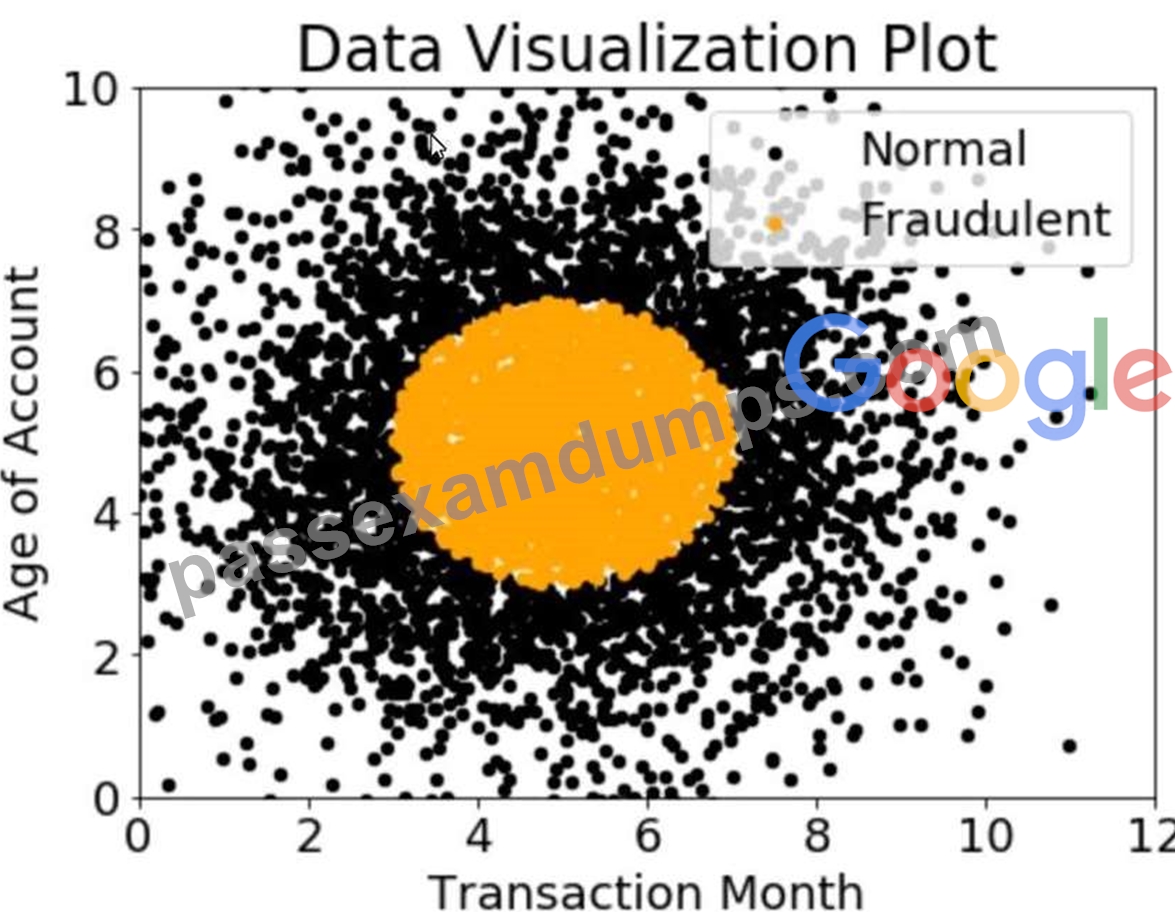
Based on this information, which model would have the HIGHEST accuracy?
- A. Support vector machine (SVM) with non-linear kernel
- B. Logistic regression
- C. Single perceptron with tanh activation function
- D. Long short-term memory (LSTM) model with scaled exponential linear unit (SELU)
Answer: A
NEW QUESTION 42
You work for a large technology company that wants to modernize their contact center. You have been asked to develop a solution to classify incoming calls by product so that requests can be more quickly routed to the correct support team. You have already transcribed the calls using the Speech-to-Text API. You want to minimize data preprocessing and development time. How should you build the model?
- A. Build a custom model to identify the product keywords from the transcribed calls, and then run the keywords through a classification algorithm
- B. Use AutoML Natural Language to extract custom entities for classification
- C. Use the Al Platform Training built-in algorithms to create a custom model
- D. Use the Cloud Natural Language API to extract custom entities for classification
Answer: C
NEW QUESTION 43
A data scientist uses an Amazon SageMaker notebook instance to conduct data exploration and analysis. This requires certain Python packages that are not natively available on Amazon SageMaker to be installed on the notebook instance.
How can a machine learning specialist ensure that required packages are automatically available on the notebook instance for the data scientist to use?
- A. Use the conda package manager from within the Jupyter notebook console to apply the necessary conda packages to the default kernel of the notebook.
- B. Install AWS Systems Manager Agent on the underlying Amazon EC2 instance and use Systems Manager Automation to execute the package installation commands.
- C. Create a Jupyter notebook file (.ipynb) with cells containing the package installation commands to execute and place the file under the /etc/init directory of each Amazon SageMaker notebook instance.
- D. Create an Amazon SageMaker lifecycle configuration with package installation commands and assign the lifecycle configuration to the notebook instance.
Answer: C
Explanation:
Explanation
Explanation/Reference: https://towardsdatascience.com/automating-aws-sagemaker-notebooks-2dec62bc2c84
NEW QUESTION 44
A manufacturing company has a large set of labeled historical sales data. The manufacturer would like to predict how many units of a particular part should be produced each quarter.
Which machine learning approach should be used to solve this problem?
- A. Logistic regression
- B. Random Cut Forest (RCF)
- C. Linear regression
- D. Principal component analysis (PCA)
Answer: B
NEW QUESTION 45
A Data Scientist is developing a machine learning model to predict future patient outcomes based on information collected about each patient and their treatment plans. The model should output a continuous value as its prediction. The data available includes labeled outcomes for a set of 4,000 patients. The study was conducted on a group of individuals over the age of 65 who have a particular disease that is known to worsen with age.
Initial models have performed poorly. While reviewing the underlying data, the Data Scientist notices that, out of 4,000 patient observations, there are 450 where the patient age has been input as 0. The other features for these observations appear normal compared to the rest of the sample population How should the Data Scientist correct this issue?
- A. Drop all records from the dataset where age has been set to 0.
- B. Use k-means clustering to handle missing features
- C. Replace the age field value for records with a value of 0 with the mean or median value from the dataset
- D. Drop the age feature from the dataset and train the model using the rest of the features.
Answer: A
Explanation:
Explanation
NEW QUESTION 46
You are training an LSTM-based model on Al Platform to summarize text using the following job submission script: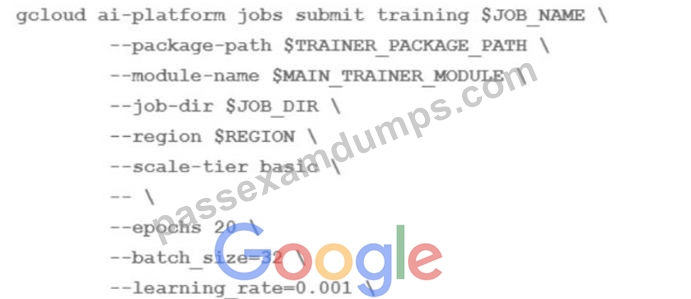
You want to ensure that training time is minimized without significantly compromising the accuracy of your model. What should you do?
- A. Modify the 'scale-tier' parameter
- B. Modify the 'learning rate' parameter
- C. Modify the batch size' parameter
- D. Modify the 'epochs' parameter
Answer: C
NEW QUESTION 47
You work for a bank and are building a random forest model for fraud detection. You have a dataset that includes transactions, of which 1% are identified as fraudulent.
Which data transformation strategy would likely improve the performance of your classifier?
- A. Use one-hot encoding on all categorical features.
- B. Z-normalize all the numeric features.
- C. Oversample the fraudulent transaction 10 times.
- D. Write your data in TFRecords.
Answer: C
NEW QUESTION 48
......
Resources From:
- 2021 Latest PassExamDumps Professional-Machine-Learning-Engineer Exam Dumps (PDF & Exam Engine) Free Share: https://www.passexamdumps.com/Professional-Machine-Learning-Engineer-valid-exam-dumps.html
- 2021 Latest PassExamDumps Professional-Machine-Learning-Engineer PDF and Professional-Machine-Learning-Engineer Exam Dumps Free Share: https://drive.google.com/open?id=1-jr0PiZm0abDfxI66i6CJTuNXwgD3SHi
Free Resources from PassExamDumps, We Devoted to Helping You 100% Pass All Exams!
