

May 10, 2024 Newest ARA-R01 Exam Dumps – Achieve Success in Actual ARA-R01 Exam
Updated Snowflake ARA-R01 Dumps – Check Free ARA-R01 Exam Dumps (2024)
NEW QUESTION # 63
What Snowflake features should be leveraged when modeling using Data Vault?
- A. Snowflake's ability to hash keys so that hash key joins can run faster than integer joins
- B. Snowflake's support of multi-table inserts into the data model's Data Vault tables
- C. Scaling up the virtual warehouses will support parallel processing of new source loads
- D. Data needs to be pre-partitioned to obtain a superior data access performance
Answer: B,C
Explanation:
These two features are relevant for modeling using Data Vault on Snowflake. Data Vault is a data modeling approach that organizes data into hubs, links, and satellites. Data Vault is designed to enable high scalability, flexibility, and performance for data integration and analytics. Snowflake is a cloud data platform that supports various data modeling techniques, including Data Vault. Snowflake provides some features that can enhance the Data Vault modeling, such as:
Snowflake's support of multi-table inserts into the data model's Data Vault tables. Multi-table inserts (MTI) are a feature that allows inserting data from a single query into multiple tables in a single DML statement. MTI can improve the performance and efficiency of loading datainto Data Vault tables, especially for real-time or near-real-time data integration. MTI can also reduce the complexity and maintenance of the loading code, as well as the data duplication and latency12.
Scaling up the virtual warehouses will support parallel processing of new source loads. Virtual warehouses are a feature that allows provisioning compute resources on demand for data processing.
Virtual warehouses can be scaled up or down by changing the size of the warehouse, which determines the number of servers in the warehouse. Scaling up the virtual warehouses can improve the performance and concurrency of processing new source loads into Data Vault tables, especially for large or complex data sets. Scaling up the virtual warehouses can also leverage the parallelism and distribution of Snowflake's architecture, which can optimize the data loading and querying34.
References:
Snowflake Documentation: Multi-table Inserts
Snowflake Blog: Tips for Optimizing the Data Vault Architecture on Snowflake Snowflake Documentation: Virtual Warehouses Snowflake Blog: Building a Real-Time Data Vault in Snowflake
NEW QUESTION # 64
How can an Architect enable optimal clustering to enhance performance for different access paths on a given table?
- A. Create multiple clustering keys for a table.
- B. Create a clustering key that contains all columns used in the access paths.
- C. Create multiple materialized views with different cluster keys.
- D. Create super projections that will automatically create clustering.
Answer: C
Explanation:
According to the SnowPro Advanced: Architect documents and learning resources, the best way to enable optimal clustering to enhance performance for different access paths on a given table is to create multiple materialized views with different cluster keys. A materialized view is a pre-computedresult set that is derived from a query on one or more base tables. A materialized view can be clustered by specifying a clustering key, which is a subset of columns or expressions that determines how the data in the materialized view is co-located in micro-partitions. By creating multiple materialized views with different cluster keys, an Architect can optimize the performance of queries that use different access paths on the same base table. For example, if a base table has columns A, B, C, and D, and there are queries that filter on A and B, or on C and D, or on A and C, the Architect can create three materialized views, each with a different cluster key: (A, B), (C, D), and (A, C). This way, each query can leverage the optimal clustering of the corresponding materialized view and achieve faster scan efficiency and better compression.
References:
Snowflake Documentation: Materialized Views
Snowflake Learning: Materialized Views
https://www.snowflake.com/blog/using-materialized-views-to-solve-multi-clustering-performance-problems/
NEW QUESTION # 65
What does a Snowflake Architect need to consider when implementing a Snowflake Connector for Kafka?
- A. The Kafka connector will create one table and one pipe to ingest data for each topic. If the connector cannot create the table or the pipe it will result in an exception.
- B. The Kafka connector supports key pair authentication, OAUTH. and basic authentication (for example, username and password).
- C. Every Kafka message is in JSON or Avro format.
- D. The default retention time for Kafka topics is 14 days.
Answer: A
Explanation:
The Snowflake Connector for Kafka is a Kafka Connect sink connector that reads data from one or more Apache Kafka topics and loads the data into a Snowflake table. The connector supports different authentication methods to connect to Snowflake, such as key pair authentication, OAUTH, and basic authentication (for example, username and password). The connector also supports different encryption methods, such as HTTPS and SSL1. The connector does not require that every Kafka message is in JSON or Avro format, as it can handle other formats such as CSV, XML, and Parquet2. The default retention time for Kafka topics is not relevant for the connector, as it only consumes themessages that are available in the topics and does not store them in Kafka. The connector will create one table and one pipe to ingest data for each topic by default, but this behavior can be customized by using the snowflake.topic2table.map configuration property3. If the connector cannot create the table or the pipe, it will log an error and retry the operation until it succeeds or the connector is stopped4. References:
Installing and Configuring the Kafka Connector
Overview of the Kafka Connector
Managing the Kafka Connector
Troubleshooting the Kafka Connector
NEW QUESTION # 66
A user is executing the following command sequentially within a timeframe of 10 minutes from start to finish:
What would be the output of this query?
- A. Time Travel data is not available for table T_SALES.
- B. Syntax error line 1 at position 58 unexpected 'at'.
- C. The offset -> is not a valid clause in the clone operation.
- D. Table T_SALES_CLONE successfully created.
Answer: D
Explanation:
The query is executing a clone operation on an existing tablet_saleswith an offset to account for the retention time. The syntax used is correct for cloning a table in Snowflake, and the use of theat(offset => -60*30)clause is valid. This specifies that the clone should be based on the state of the table 30 minutes prior (60 seconds *
30). Assuming the tablet_salesexists and has been modified within the last 30 minutes, and considering the data_retention_time_in_daysisset to 1 day (which enables time travel queries for the past 24 hours), the table t_sales_clonewould be successfully created based on the state oft_sales30 minutes before the clone command was issued.
NEW QUESTION # 67
How can the Snowflake context functions be used to help determine whether a user is authorized to see data that has column-level security enforced? (Select TWO).
- A. Assign the accountadmin role to the user who is executing the object.
- B. Set masking policy conditions using invoker_role targeting the executing role in a SQL statement.
- C. Set masking policy conditions using current_role targeting the role in use for the current session.
- D. Determine if there are ownership privileges on the masking policy that would allow the use of any function.
- E. Set masking policy conditions using is_role_in_session targeting the role in use for the current account.
Answer: B,C
Explanation:
Snowflake context functions are functions that return information about the current session, user, role, warehouse, database, schema, or object. They can be used to helpdetermine whether a user is authorized to see data that has column-level security enforced by setting masking policy conditions based on the context functions. The following context functions are relevant for column-level security:
current_role: This function returns the name of the role in use for the current session. It can be used to set masking policy conditions that target the current session and are not affected by the execution context of the SQL statement. For example, a masking policy condition using current_role can allow or deny access to a column based on the role that the user activated in the session.
invoker_role: This function returns the name of the executing role in a SQL statement. It can be used to set masking policy conditions that target the executing role and are affected by the execution context of the SQL statement. For example, a masking policy condition using invoker_role can allow or deny access to a column based on the role that the user specified in the SQL statement, such as using the AS ROLE clause or a stored procedure.
is_role_in_session: This function returns TRUE if the user's current role in the session (i.e. the role returned by current_role) inherits the privileges of the specified role. It can be used to set masking policy conditions that involve role hierarchy and privilege inheritance. For example, a masking policy condition using is_role_in_session can allow or deny access to a column based on whether the user's current role is a lower privilege role in the specified role hierarchy.
The other options are not valid ways to use the Snowflake context functions for column-level security:
Set masking policy conditions using is_role_in_session targeting the role in use for the current account.
This option is incorrect because is_role_in_session does not target the role in use for the current account, but rather the role in use for the current session. Also, the current account is not a role, but rather a logical entity that contains users, roles, warehouses, databases, and other objects.
Determine if there are ownership privileges on the masking policy that would allow the use of any function. This option is incorrect because ownership privileges on the masking policy do not affect the use of any function, but rather the ability to create, alter, or drop the masking policy. Also, this is not a way to use the Snowflake context functions, but rather a way to check the privileges on the masking policy object.
Assign the accountadmin role to the user who is executing the object. This option is incorrect because assigning the accountadmin role to the user who is executing the object does not involve using the Snowflake context functions, but rather granting the highest-level role to the user. Also, this is not a recommended practice for column-level security, as it would give the user full access to all objects and data in the account, which could compromise data security and governance.
References:
Context Functions
Advanced Column-level Security topics
Snowflake Data Governance: Column Level Security Overview
Data Security Snowflake Part 2 - Column Level Security
NEW QUESTION # 68
A table for IOT devices that measures water usage is created. The table quickly becomes large and contains more than 2 billion rows.
The general query patterns for the table are:
1. DeviceId, lOT_timestamp and Customerld are frequently used in the filter predicate for the select statement
2. The columns City and DeviceManuf acturer are often retrieved
3. There is often a count on Uniqueld
Which field(s) should be used for the clustering key?
- A. lOT_timestamp
- B. Uniqueld
- C. City and DeviceManuf acturer
- D. Deviceld and Customerld
Answer: D
Explanation:
A clustering key is a subset of columns or expressions that are used to co-locate the data in the same micro-partitions, which are the units of storage in Snowflake. Clustering can improve the performance of queries that filter on the clustering key columns, as it reduces the amount of data that needs to be scanned. The best choice for a clustering key depends on the query patterns and the data distribution in the table. In this case, the columns DeviceId, IOT_timestamp, and CustomerId are frequently used in the filter predicate for the select statement, which means they are good candidates for the clustering key. The columns City and DeviceManufacturer are often retrieved, but not filtered on, so they are not as important for the clustering key.
The column UniqueId is used for counting, but it is not a good choice for the clustering key, as it is likely to have a high cardinality and a uniform distribution, which means it will not help to co-locate the data.
Therefore, the best option is to use DeviceId and CustomerId as the clustering key, as they can help to prune the micro-partitions and speed up thequeries. References: Clustering Keys & Clustered Tables, Micro-partitions & Data Clustering, A Complete Guide to Snowflake Clustering
NEW QUESTION # 69
What is a characteristic of loading data into Snowflake using the Snowflake Connector for Kafka?
- A. The Connector works with all file formats, including text, JSON, Avro, Ore, Parquet, and XML.
- B. The Connector only works in Snowflake regions that use AWS infrastructure.
- C. The Connector creates and manages its own stage, file format, and pipe objects.
- D. Loads using the Connector will have lower latency than Snowpipe and will ingest data in real time.
Answer: C
Explanation:
According to the SnowPro Advanced: Architect documents and learning resources, a characteristic of loading data into Snowflake using the Snowflake Connector for Kafka is that the Connector creates and manages its own stage, file format, and pipe objects. The stage is an internal stage that is used to store the data files from the Kafka topics. The file format is a JSON or Avro file format that is used to parse the data files. The pipe is a Snowpipe object that is used to load the data files into the Snowflake table. The Connector automatically creates and configures these objects based on the Kafka configuration properties, and handles the cleanup and maintenance of these objects1.
The other options are incorrect because they are not characteristics of loading data into Snowflake using the Snowflake Connector for Kafka. Option A is incorrect because the Connector works in Snowflake regions that use any cloud infrastructure, not just AWS. The Connector supports AWS, Azure, and Google Cloud platforms, and can load data across different regions and cloud platforms using data replication2. Option B is incorrect because the Connector does not work with all file formats,only JSON and Avro. The Connector expects the data in the Kafka topics to be in JSON or Avro format, and parses the data accordingly. Other file formats, such as text, ORC, Parquet, or XML, are not supported by the Connector3. Option D is incorrect because loads using the Connector do not have lower latency than Snowpipe, and do not ingest data in real time. The Connector uses Snowpipe to load data into Snowflake, and inherits the same latency and performance characteristics of Snowpipe. The Connector does not provide real-time ingestion, but near real-time ingestion, depending on the frequency and size of the data files4. References: Installing and Configuring the Kafka Connector | Snowflake Documentation, Sharing Data Across Regions and Cloud Platforms | Snowflake Documentation, Overview of the Kafka Connector | Snowflake Documentation, Using Snowflake Connector for Kafka With Snowpipe Streaming | Snowflake Documentation
NEW QUESTION # 70
An Architect runs the following SQL query: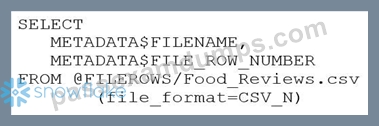
How can this query be interpreted?
- A. FILEROWS is a file. FILE_ROW_NUMBER is the file format location.
- B. FILEROWS is a stage. FILE_ROW_NUMBER is line number in file.
- C. FILEROWS is the table. FILE_ROW_NUMBER is the line number in the table.
- D. FILERONS is the file format location. FILE_ROW_NUMBER is a stage.
Answer: B
Explanation:
A stage is a named location in Snowflake that can store files for data loading and unloading. A stage can be internal or external, depending on where the files are stored.
The query in the question uses the LIST function to list the files in a stage named FILEROWS. The function returns a table with various columns, including FILE_ROW_NUMBER, which is the line number of the file in the stage.
Therefore, the query can be interpreted as listing the files in a stage named FILEROWS and showing the line number of each file in the stage.
References:
: Stages
: LIST Function
NEW QUESTION # 71
A company has a Snowflake environment running in AWS us-west-2 (Oregon). The company needs to share data privately with a customer who is running their Snowflake environment in Azure East US 2 (Virginia).
What is the recommended sequence of operations that must be followed to meet this requirement?
- A. 1. Ask the customer to create a new Snowflake account in Azure EAST US 2 (Virginia)
2. Create a share and add the database privileges to the share
3. Alter the share and add the customer's Snowflake account to the share - B. 1. Create a new Snowflake account in Azure East US 2 (Virginia)
2. Set up replication between AWS us-west-2 (Oregon) and Azure East US 2 (Virginia) for the database objects to be shared
3. Create a share and add the database privileges to the share
4. Alter the share and add the customer's Snowflake account to the share - C. 1. Create a reader account in Azure East US 2 (Virginia)
2. Create a share and add the database privileges to the share
3. Add the reader account to the share
4. Share the reader account's URL and credentials with the customer - D. 1. Create a share and add the database privileges to the share
2. Create a new listing on the Snowflake Marketplace
3. Alter the listing and add the share
4. Instruct the customer to subscribe to the listing on the Snowflake Marketplace
Answer: B
Explanation:
Option C is the correct answer because it allows the company to share data privately with the customer across different cloud platforms and regions. The company can create a new Snowflake account in Azure East US 2 (Virginia) and set up replication between AWS us-west-2 (Oregon) and Azure East US 2 (Virginia) for the database objects to be shared. This way, the company can ensure that the data is always up to date and consistent in both accounts. The company can then create a share and add the database privileges to the share, and alter the share and add the customer's Snowflake account to the share. The customer can then access the shared data from their own Snowflake account in Azure East US 2 (Virginia).
Option A is incorrect because the Snowflake Marketplace is not a private way of sharing data. The Snowflake Marketplace is a public data exchange platform that allows anyone to browse and subscribe to data sets from various providers. The company would not be able to control who can access their data if they use the Snowflake Marketplace.
Option B is incorrect because it requires the customer to create a new Snowflake account in Azure East US 2 (Virginia), which may not be feasible or desirable for the customer. The customer may already have an existing Snowflake account in a different cloud platform or region, and may not want to incur additional costs or complexity by creating a new account.
Option D is incorrect because it involves creating a reader account in Azure East US 2 (Virginia), which is a limited and temporary way of sharing data. A reader account is a special type of Snowflake account that can only access data from a single share, and has a fixed duration of 30 days. The company would have to manage the reader account's URL and credentials, and renew the account every 30 days. The customer would not be able to use their own Snowflake account to access the shared data, and would have to rely on the company's reader account.
References:
Snowflake Replication
Secure Data Sharing Overview
Snowflake Marketplace Overview
Reader Account Overview
NEW QUESTION # 72
At which object type level can the APPLY MASKING POLICY, APPLY ROW ACCESS POLICY and APPLY SESSION POLICY privileges be granted?
- A. Table
- B. Schema
- C. Global
- D. Database
Answer: C
Explanation:
The object type level at which the APPLY MASKING POLICY, APPLY ROW ACCESS POLICY and APPLY SESSION POLICY privileges can be granted is global. These are account-level privileges that control who can apply or unset these policies on objects such as columns, tables, views, accounts, or users. These privileges are granted to the ACCOUNTADMIN role by default, and can be granted to other roles as needed.
The other options are incorrect because they are not the object type level at which these privileges can be granted. Database, schema, and table are lower-level object types that do not support these privileges. References: Access Control Privileges | Snowflake Documentation, Using Dynamic Data Masking | Snowflake Documentation, Using Row Access Policies | Snowflake Documentation, Using Session Policies | Snowflake Documentation
NEW QUESTION # 73
The Data Engineering team at a large manufacturing company needs to engineer data coming from many sources to support a wide variety of use cases and data consumer requirements which include:
1) Finance and Vendor Management team members who require reporting and visualization
2) Data Science team members who require access to raw data for ML model development
3) Sales team members who require engineered and protected data for data monetization What Snowflake data modeling approaches will meet these requirements? (Choose two.)
- A. Consolidate data in the company's data lake and use EXTERNAL TABLES.
- B. Create a single star schema in a single database to support all consumers' requirements.
- C. Create a raw database for landing and persisting raw data entering the data pipelines.
- D. Create a Data Vault as the sole data pipeline endpoint and have all consumers directly access the Vault.
- E. Create a set of profile-specific databases that aligns data with usage patterns.
Answer: C,E
Explanation:
These two approaches are recommended by Snowflake for data modeling in a data lake scenario. Creating a raw database allows the data engineering team to ingest data from various sources without any transformation or cleansing, preserving the original data quality and format. This enables the data science team to access the raw data for ML model development. Creating a set of profile-specific databases allows the data engineering team to apply different transformations and optimizations for different use cases and data consumer requirements. For example, the finance and vendor management team can access a dimensional database that supports reporting and visualization, while the sales team can access a secure database that supports data monetization.
References:
Snowflake Data Lake Architecture | Snowflake Documentation
Snowflake Data Lake Best Practices | Snowflake Documentation
NEW QUESTION # 74
A table contains five columns and it has millions of records. The cardinality distribution of the columns is shown below:
Column C4 and C5 are mostly used by SELECT queries in the GROUP BY and ORDER BY clauses.
Whereas columns C1, C2 and C3 are heavily used in filter and join conditions of SELECT queries.
The Architect must design a clustering key for this table to improve the query performance.
Based on Snowflake recommendations, how should the clustering key columns be ordered while defining the multi-column clustering key?
- A. C5, C4, C2
- B. C2, C1, C3
- C. C1, C3, C2
- D. C3, C4, C5
Answer: C
Explanation:
According to the Snowflake documentation, the following are some considerations for choosing clustering for a table1:
Clustering is optimal when either:
You require the fastest possible response times, regardless of cost.
Your improved query performance offsets the credits required to cluster and maintain the table.
Clustering is most effective when the clustering key is used in the following types of query predicates:
Filter predicates (e.g. WHERE clauses)
Join predicates (e.g. ON clauses)
Grouping predicates (e.g. GROUP BY clauses)
Sorting predicates (e.g. ORDER BY clauses)
Clustering is less effective when the clustering key is not used in any of the above query predicates, or when the clustering key is used in a predicate that requires a function or expression to be applied to the key (e.g. DATE_TRUNC, TO_CHAR, etc.).
For most tables, Snowflake recommends a maximum of 3 or 4 columns (or expressions) per key.
Adding more than 3-4 columns tends to increase costs more than benefits.
Based on these considerations, the best option for the clustering key columns is C. C1, C3, C2, because:
These columns are heavily used in filter and join conditions of SELECT queries, which are the most effective types of predicates for clustering.
These columns have high cardinality, which means they have many distinct values and can help reduce the clustering skew and improve the compression ratio.
These columns are likely to be correlated with each other, which means they can help co-locate similar rows in the same micro-partitions and improve the scan efficiency.
These columns do not require any functions or expressions to be applied to them, which means they can be directly used in the predicates without affecting the clustering.
References: 1: Considerations for Choosing Clustering for a Table | Snowflake Documentation
NEW QUESTION # 75
A Snowflake Architect is setting up database replication to support a disaster recovery plan. The primary database has external tables.
How should the database be replicated?
- A. Create a clone of the primary database then replicate the database.
- B. Share the primary database with an account in the same region that the database will be replicated to.
- C. Move the external tables to a database that is not replicated, then replicate the primary database.
- D. Replicate the database ensuring the replicated database is in the same region as the external tables.
Answer: C
Explanation:
Database replication is a feature that allows you to create a copy of a database in another account, region, or cloud platform for disaster recovery or business continuity purposes. However, not all database objects can be replicated. External tables are one of the exceptions, as they reference data files stored in an external stage that is not part of Snowflake. Therefore, to replicate a database that contains external tables, you need to move the external tables to a separate database that is not replicated, and then replicate the primary database that contains the other objects. This way, you can avoid replication errors and ensure consistency between the primary and secondary databases. The other options are incorrect because they either do not address the issue of external tables, or they use an alternative method that is not supported by Snowflake. You cannot create a clone of the primary database and then replicate it, as replication only works on the original database, not on its clones. You also cannot share the primary database with another account, as sharing is a different feature that does not create a copy of the database, but rather grants access to the shared objects. Finally, you do not need to ensure that the replicated database is in the same region as the external tables, as external tables can access data files stored in any region or cloud platform, as long as the stage URL is valid and accessible. References:
[Replication and Failover/Failback] 1
[Introduction to External Tables] 2
[Working with External Tables] 3
[Replication : How to migrate an account from One Cloud Platform or Region to another in Snowflake] 4
NEW QUESTION # 76
Which Snowflake objects can be used in a data share? (Select TWO).
- A. Stream
- B. External table
- C. Stored procedure
- D. Standard view
- E. Secure view
Answer: D,E
Explanation:
Data sharing is a feature that allows you to share selected objects in a database in your account with other Snowflake accounts. You can share the following Snowflake database objects: external tables, dynamic tables, secure views, secure materialized views, secure UDFs, and tables. However, not all of these objects can be used in a data share. A data share is a named object that encapsulates the information required to share a database. You can grant privileges on objects to a share either via a database role or directly to a share. The objects that can be granted privileges directly to a share are: standard views, secure views, secure UDFs, and tables.
Therefore, the correct answer is A and B.
The other options are incorrect because they cannot be granted privileges directly to a share. External tables, dynamic tables, and streams can only be shared via a database role. Stored procedures cannot be shared at all. References:
[Introduction to Secure Data Sharing] 1
[Working with Shares] 2
[Choosing How to Share Database Objects] 3
NEW QUESTION # 77
What are some of the characteristics of result set caches? (Choose three.)
- A. Time Travel queries can be executed against the result set cache.
- B. Snowflake persists the data results for 24 hours.
- C. The result set cache is not shared between warehouses.
- D. The data stored in the result cache will contribute to storage costs.
- E. The retention period can be reset for a maximum of 31 days.
- F. Each time persisted results for a query are used, a 24-hour retention period is reset.
Answer: B,E,F
Explanation:
Comprehensive and Detailed Explanation: According to the SnowPro Advanced: Architect documents and learning resources, some of the characteristics of result set caches are:
Snowflake persists the data results for 24 hours. This means that the result set cache holds the results of every query executed in the past 24 hours, and can be reused if the same query is submitted again and the underlying data has not changed1.
Each time persisted results for a query are used, a 24-hour retention period is reset. This means that the result set cache extends the lifetime of the results every time they are reused, up to a maximum of 31 days from the date and time that the query was first executed1.
The retention period can be reset for a maximum of 31 days. This means that the result set cache will purge the results after 31 days, regardless of whether they are reused or not. After 31 days, the next time the query is submitted, a new result is generated and persisted1.
The other options are incorrect because they are not characteristics of result set caches. Option A is incorrect because Time Travel queries cannot be executed against the result set cache. Time Travel queries use the AS OF clause to access historical data that is stored in the storage layer, not the result set cache2. Option D is incorrect because the data stored in the result set cache does not contribute to storage costs. The result set cache is maintained by the service layer, and does not incurany additional charges1. Option F is incorrect because the result set cache is shared between warehouses. The result set cache is available across virtual warehouses, so query results returned to one user are available to any other user on the system who executes the same query, provided the underlying data has not changed1. References: Using Persisted Query Results | Snowflake Documentation, Time Travel | Snowflake Documentation
NEW QUESTION # 78
An Architect needs to automate the daily Import of two files from an external stage into Snowflake. One file has Parquet-formatted data, the other has CSV-formatted data.
How should the data be joined and aggregated to produce a final result set?
- A. Create a materialized view to read, Join, and aggregate the data directly from the external stage, and use the view to produce the final result set
- B. Create a task using Snowflake scripting that will import the files, and then call a User-Defined Function (UDF) to produce the final result set.
- C. Use Snowpipe to ingest the two files, then create a materialized view to produce the final result set.
- D. Create a JavaScript stored procedure to read. join, and aggregate the data directly from the external stage, and then store the results in a table.
Answer: B
Explanation:
According to the Snowflake documentation, tasks are objects that enable scheduling and execution of SQL statements or JavaScript user-defined functions (UDFs) in Snowflake. Tasks can be used to automate data loading, transformation, and maintenance operations. Snowflake scripting is a feature that allows writing procedural logic using SQL statements and JavaScript UDFs. Snowflake scripting can be used to create complex workflows and orchestrate tasks. Therefore, the best option to automate the daily import of two files from an external stage into Snowflake, join and aggregate the data, and produce a final result set is to create a task using Snowflake scripting that will import the files using the COPY INTO command, and then call a UDF to perform the join and aggregation logic. The UDF can return a table or a variant value as the final result set. References:
Tasks
Snowflake Scripting
User-Defined Functions
NEW QUESTION # 79
A company has a source system that provides JSON records for various loT operations. The JSON Is loading directly into a persistent table with a variant field. The data Is quickly growing to 100s of millions of records and performance to becoming an issue. There is a generic access pattern that Is used to filter on the create_date key within the variant field.
What can be done to improve performance?
- A. Alter the target table to Include additional fields pulled from the JSON records. This would Include a create_date field with a datatype of time stamp. When this field Is used in the filter, partition pruning will occur.
- B. Alter the target table to include additional fields pulled from the JSON records. This would include a create_date field with a datatype of varchar. When this field is used in the filter, partition pruning will occur.
- C. Validate the size of the warehouse being used. If the record count is approaching 100s of millions, size XL will be the minimum size required to process this amount of data.
- D. Incorporate the use of multiple tables partitioned by date ranges. When a user or process needs to query a particular date range, ensure the appropriate base table Is used.
Answer: A
Explanation:
The correct answer is A because it improves the performance of queries by reducing the amount of data scanned and processed. By adding a create_date field with a timestamp data type, Snowflake can automatically cluster the table based on this field and prune the micro-partitions that do not match the filter condition. This avoids the need to parse the JSON data and access the variant field for every record.
Option B is incorrect because it does not improve the performance of queries. By adding a create_date field with a varchar data type, Snowflake cannot automatically cluster the table based on this field and prune the micro-partitions that do not match the filter condition. This still requires parsing the JSON data and accessing the variant field for every record.
Option C is incorrect because it does not address the root cause of the performance issue. By validating the size of the warehouse being used, Snowflake can adjust the compute resources to match the data volume and parallelize the query execution. However, this does not reduce the amount of data scanned and processed, which is the main bottleneck for queries on JSON data.
Option D is incorrect because it adds unnecessary complexity and overhead to the data loading and querying process. By incorporating the use of multiple tables partitioned by date ranges, Snowflake can reduce the amount of data scanned and processed for queries that specify a date range. However, this requires creating and maintaining multiple tables, loading data into the appropriate table based on the date, and joining the tables for queries that span multiple date ranges. References:
Snowflake Documentation: Loading Data Using Snowpipe: This document explains how to use Snowpipe to continuously load data from external sources into Snowflake tables. It also describes the syntax and usage of the COPY INTO command, which supports various options and parameters to control the loading behavior, such as ON_ERROR, PURGE, and SKIP_FILE.
Snowflake Documentation: Date and Time Data Types and Functions: This document explains the different data types and functions for working with date and time values in Snowflake. It also describes how to set and change the session timezone and the system timezone.
Snowflake Documentation: Querying Metadata: This document explains how to query the metadata of the objects and operations in Snowflake using various functions, views, and tables. It also describes how to access the copy history information using the COPY_HISTORY function or the COPY_HISTORY view.
Snowflake Documentation: Loading JSON Data: This document explains how to load JSON data into Snowflake tables using various methods, such as the COPY INTO command, the INSERT command, or the PUT command. It also describes how to access and query JSON data using the dot notation, the FLATTEN function, or the LATERAL join.
Snowflake Documentation: Optimizing Storage for Performance: This document explains how to optimize the storage of data in Snowflake tables to improve the performance of queries. It also describes the concepts and benefits of automatic clustering, search optimization service, and materialized views.
NEW QUESTION # 80
A company's daily Snowflake workload consists of a huge number of concurrent queries triggered between
9pm and 11pm. At the individual level, these queries are smaller statements that get completed within a short time period.
What configuration can the company's Architect implement to enhance the performance of this workload?
(Choose two.)
- A. Reduce the amount of data that is being processed through this workload.
- B. Increase the size of the virtual warehouse to size X-Large.
- C. Set the MAX_CONCURRENCY_LEVEL to a higher value than its default value of 8 at the virtual warehouse level.
- D. Set the connection timeout to a higher value than its default.
- E. Enable a multi-clustered virtual warehouse in maximized mode during the workload duration.
Answer: C,E
Explanation:
These two configuration options can enhance the performance of the workload that consists of a huge number of concurrent queries that are smaller and faster.
Enabling a multi-clustered virtual warehouse in maximized mode allows the warehouse to scale out automatically by adding more clusters as soon as the current cluster is fully loaded, regardless of the number of queries in the queue. This can improve the concurrency and throughput of the workload by minimizing or preventing queuing. The maximized mode is suitable for workloads that require high performance and low latency, and are less sensitive to credit consumption1.
Setting the MAX_CONCURRENCY_LEVEL to a higher value than its default value of 8 at the virtual warehouse level allows the warehouse to run more queries concurrently on each cluster. This can improve the utilization and efficiency of the warehouse resources, especially for smaller and faster queries that do not require a lot of processing power. The MAX_CONCURRENCY_LEVEL parameter can be set when creating or modifying a warehouse, and it can be changed at any time2.
References:
Snowflake Documentation: Scaling Policy for Multi-cluster Warehouses
Snowflake Documentation: MAX_CONCURRENCY_LEVEL
NEW QUESTION # 81
......
Actual ARA-R01 Exam Recently Updated Questions with Free Demo: https://www.passexamdumps.com/ARA-R01-valid-exam-dumps.html
Valid ARA-R01 exam with Snowflake Real Exam Questions: https://drive.google.com/open?id=1w9S4oq4kwT70sv7VeUdGctEdN48WqaBE
