

Free Oracle Database 19c 1Z0-083 Ultimate Study Guide (Updated 160 Questions)
Get to the Top with 1Z0-083 Practice Exam Questions
Average Salary of Oracle Database Administration II Exam Number: 1Z0-083 Certified Professionals
The average salary is between $69k and $127k.
Certification Path for Oracle Database Administration II Exam Number: 1Z0-083
Oracle Database Administration II Exam Number: 1Z0-083 is an advanced exam. Successful completion by candidates of Data Administrator I and II will allow them to achieve Oracle Certified Database Administrator status.
NEW QUESTION 92
Which three are true about transporting databases across platforms using Recovery Manager (RMAN) image copies? (Choose three.)
- A. Data files can be converted on the source system.
- B. The password file is automatically converted by RMAN.
- C. By default, the transported database will use Oracle Managed Files (OMF)
- D. Databases can be transported between systems with different endian formats.
- E. A new DBID is automatically created for the transported database.
- F. Data files can be converted on the destination system.
Answer: A,C,F
Explanation:
Explanation
A: If you do not provide a destination, then the DB_FILE_CREATE_DEST initialization parameter must be set in the target platform. RMAN restores the data files to the location specified by this parameter using new Oracle Managed File (OMF) names. BC: While creating the cross-platform backup to transport a database, you can convert the database either on the source database or the destination database. The benefit of performing the conversion on the destination database is that the processing overhead of the convert operation is offloaded from the source to the destination database.
NEW QUESTION 93
Examine these queries and their output: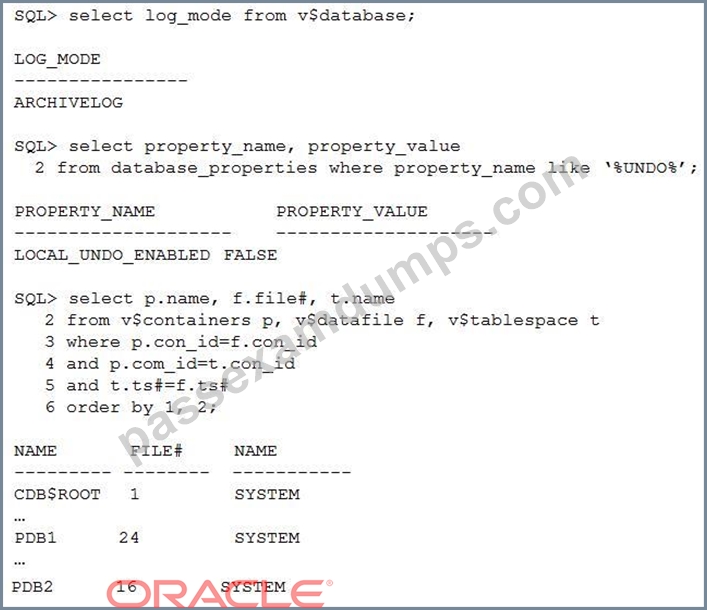
After a system crash, an instance restart and an attempted opening of the PDBs result in: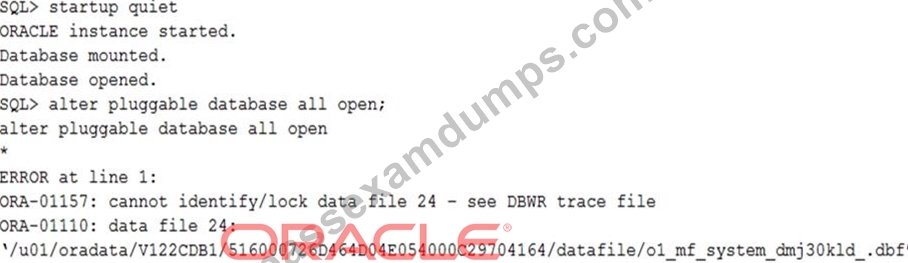
Which two are true? (Choose two.)
- A. Data file 24 can be recovered while PDB2 is opened.
- B. Data file 24 can be recovered while CDB$ROOT and PDB$SEED are opened.
- C. Data file 24 must be recovered while PDB2 is closed.
- D. Data file 24 must be recovered while the CDB is opened.
- E. Data file 24 cannot be recovered while the CDB is opened.
Answer: D,E
NEW QUESTION 94
A container database called CDB1 is OMF-enabled.
PDB_FILE_NAME_CONVERT is not configured in CDB1. PDB1 was unplugged from CDB1 earlier in the week. Examine this command, which will be executed in CDB1:
CREATE PLUGGABLE DATABASE pdb1
USING '/u01/app/oracle/oradata/pdb1.xml'
SOURCE_FILE_NAME_CONVERT =
('/u01/app/oracle/oradata/', '/u02/app/oracle/oradata/');
Which two are true? (Choose two.)
- A. PDB1 data files already exist in the correct location.
- B. /u01/app/oracle/oradata/pdb1.xml does not contain the current locations of data files for PDB1.
- C. PDB_FILE_NAME_CONVERT must be set before executing the command.
- D. PDB1 must be dropped from CDB1.
- E. DBMS_PDB.CHECK_PLUG_COMPATIBILITY must be run in CDB1 before executing the command.
Answer: A,D
NEW QUESTION 95
A container database (CDB) contains two pluggable databases PDB1 and PDB2.
The LOCAL_UNDO_ENABLEDdatabase property is set to FALSEin the CDB.
Data file 24 of PDB2was deleted and you need to restore and recover it.
The only RMAN backup that exists was created with the BACKUP DATABASEcommand while connected to CDB$ROOT.
Which three are true? (Choose three.)
- A. Data file 24 can be restored and recovered while connected to CDB$ROOT.
- B. Data file 24 can be recovered while connected to PDB2.
- C. Data file 24 can be recovered only while connected to PDB2.
- D. Data file 24 can be restored only while connected to CDB$ROOT.
- E. Data file 24 can be restored only while connected to PDB2.
- F. Data file 24 can be recovered while connected to CDB$ROOT.
Answer: A,E,F
NEW QUESTION 96
Which two are true about Oracle instance recovery? (Choose three.)
- A. Recovery begins from the last checkpoint position that was recorded in the control file by the checkpoint process (CKPT).
- B. Recovery begins from the last checkpoint position that wascalculated by the Database Writer before instance failure.
- C. Recovery begins from the beginning of the CURRENT redo log group.
- D. Recovery begins from the start of any ACTIVE redo log group or the start of the CURRENT log group if no other group is ACTIVE.
- E. Recovery reads redo until the end of the redo thread. SMON rollsback any dead transactions, and then the datanase is opened.
- F. Recovery reads redo until the end of the redo thread, and then opens the database. SMON then rolls back any dead transactions.
Answer: B,E,F
NEW QUESTION 97
Examine this configuration:
You execute these commands before upgrading the database to the current release:
For which databases will fixup scripts be created?
- A. PDB$SEED, PDB1, and PDB2 only
- B. CDB1 and PDB$SEED only
- C. CDB1, PDB$SEED, and PDB1 only
- D. CDB1, PDB1, and PDB2 only
- E. CDB1, PDB$SEED, PDB1, and PDB2
Answer: B
NEW QUESTION 98
Which three are true about an application seed pluggable database (PDB)? (Choose three.)
- A. It is automatically synchronized with its application root PDB when an application is installed.
- B. A new application PDB created by cloning an application seed PDB can have an old version of the application installed after cloning completes.
- C. A new application PDB created by cloning an application seed PDB can have an up-to-date version of the application installed after cloning completes.
- D. It cannot be added to an application container after the application container has already been created.
- E. It is not required in an application container.
- F. It is automatically synchronized with its application root PDB when an application is upgraded.
- G. It cannot be dropped from its application container.
Answer: A,C,E
NEW QUESTION 99
Your database is in ARCHIVELOG mode and you plan to use Flashback Database.
Which two features or parameters manage space availability in the fast recovery area? (Choose two.)
- A. the DB_CREATE_ONLINE_LOG_DEST_n parameter setting
- B. the DB_RECOVERY_FILE_DEST parameter setting
- C. the backup optimization policy
- D. the backup retention policy
- E. the archived log deletion policy
- F. using guaranteed UNDO retention
Answer: A,D
NEW QUESTION 100
You plan to install Oracle Grid Infrastructure for a Standalone Server and Oracle Database for the first time on a server.
Examine this command and its outcome:
# id oracle
uid=54321(oracle) gid=54321(oinstall) groups=54321(oinstall) , 54322(dba) Which two are true?
- A. oracle must be the owner of every Oracle Database installation.
- B. oracle will be granted the sysasm privilege when installing the Oracle Database software.
- C. oracle will be an owner of the Oracle Inventory.
- D. oracle can own an Oracle Database installation but not an Oracle Grid Infrastructure installation.
- E. The user account, oracle, and group, oinstall, can be used for all Oracle software installations.
Answer: D,E
NEW QUESTION 101
Which four are true about duplicating a database using Recovery Manager (RMAN)? (Choose four.)
- A. A backup of the target database is always required.
- B. A new DBID is always created for the duplicated database.
- C. A subset of the target database can be duplicated.
- D. A connection to the target database instance is always required.
- E. Duplication can be done by having the target database instance push copies to the auxiliary database instance.
- F. Duplication can be done by having the auxiliary database instance pull backup sets from the target database instance.
- G. A connection to the recovery catalog instance is always required.
- H. A connection to an auxiliary instance is always required.
Answer: C,E,F,H
Explanation:
A duplicate database is a copy of your target database. With the FOR STANDBY clause, it keeps the same unique database identifier(DBID); If FOR STANDBY not specified it creates a new DBID. The duplicate database can include the same content or only a subset from the source database. It can be in the same host or a separate host. The principal work of the duplication is performed by the auxiliary channels.These channels correspond to a server session on the auxiliary instance on the destination host for backup based duplication. For active database duplication the target channels perform the work of pushing data file copies to the auxiliary instance (if number of allocated target channels is greater than the number of allocated auxiliary channels).
NEW QUESTION 102
Examine these actions:
1. Create a new database for a recovery catalog.
2. Create a tablespace with sufficient space in the catalog database for the recovery catalog.
3. Configure archivelog mode for the catalog database.
4. Create a user to own the recovery catalog schema with quota on the tablespace that will contain the catalog.
5. Grant the recovery_catalog_owner role to the recovery catalog schema owner.
6. Grant the sysbackup privilege to the recovery catalog schema owner.
Which are the minimum actions that must be performed before executing the create catalog command?
- A. 1,3,4, 5
- B. 1,2,4, 5
- C. 2, 4, 5, 6
- D. 1,2,3,4, 5,6
- E. 2, 4, 5
Answer: A
NEW QUESTION 103
Which four are true about performing Tablespace Point -In-Time Recovery (TSPITR) using Recovery Manager (RMAN)?
- A. RMAN always includes tablespaces containing undo segments in the recovery set.
- B. It can be performed using an auxiliary instance managed by RMAN.
- C. It can be used to recover a dropped tablespace.
- D. It can be performed repeatedly until the correct time is found without using an RMAN catalog.
- E. RMAN automatically adds any required tablespaces to the recovery set to make it self-contained.
- F. flashback database must be enabled for it to work.
- G. It can be performed using anauxiliary instance managed by a DBA.
- H. It can be used to recover a truncated table.
Answer: B,D,F,G
NEW QUESTION 104
Which three are true? (Choose three.)
- A. Virtual Private Database (VPD) policies on objects in an application root are automatically synchronized with all application PDBs contained in the application container.
- B. Application-common OLS policies can be created in an application root inside an install/patch BEGIN-END block.
- C. Application-common Transparent Security Data Protection (TSDP) policies can be created only within an application install/patch BEGIN-END block.
- D. Application-common Oracle Label Security (OLS) policies cannot be created in an application root outside an install/patch BEGIN-END block.
- E. Application-common TSDP policies are always container specific.
- F. Unified auditing can be automatically synchronized to all application PDBs in an application container.
- G. Fine-grained auditing (FGA) policies in an application root are automatically synchronized to all application PDBs contained in the application container.
Answer: D,E,F
NEW QUESTION 105
Which three are true about using Database Resource Manager in an Oracle multitenant environment?
(Choose three.)
- A. A CDB-level resource plan can limit session CPU utilization.
- B. A CDB-level resource plan is mandatory when using PDB-level resource plans.
- C. A CDB-level resource plan can limit PDB CPU utilization.
- D. PDB-level resource plans can limit uncommitted UNDO per consumer group.
- E. A PDB-level resource plan can limit session PGA memory.
- F. A CDB-level resource plan can limit PDB UNDO use.
Answer: A,B,F
NEW QUESTION 106
Examine this configuration:
* CDB1 is a container database.
* PDB1 and PDB2 are pluggable databases in CDB1.
You execute these commands successfully: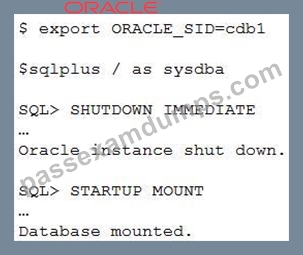
Which two are true? (Choose two.)
- A. PDB1 and PDB2 are in READ ONLY state.
- B. PDB$SEED is in READ ONLY state.
- C. PDB1 and PDB2 are in MOUNT state.
- D. CDB$ROOT is in MOUNT state.
- E. Redo logs are opened.
Answer: B,E
NEW QUESTION 107
HR_ROOT is an application container with the HR_APP application installed.
No application PDBs and no application seed have yet been created in HR_ROOT.
An application PDB, PDB1, must be created so that the HR_APP application's common objects are accessible to it.
Which two methods can be used? (Choose two.)
- A. Create the PBD1 application PDB and synchronize it with PDB$SEED.
- B. Create an application seed, synchronize it with HR_ROOT, and then create the PDB1 application PDB.
- C. Create the PBD1 application PDB and synchronize it with HR_ROOT.
- D. Create an application seed, and install HR_APP in it.
- E. Create the PDB1 application PDB and install HR_APP in it.
Answer: B,D
NEW QUESTION 108
Which three are true about using Database Upgrade Assistant (DBUA) to upgrade a database? (Choose three.)
- A. All pluggable databases are automatically upgraded as part of a container database upgrade.
- B. A whole database backup must exist before upgrade
- C. The Pre-Upgrade Information Tool script is executed by DBUA.
- D. DBUA must be launched from the target Oracle Home.
- E. Multiple databases with the same ORACLE_HOME can be upgraded simultaneously.
- F. The database must be opened in read-only mode.
Answer: A,B,C
NEW QUESTION 109
A container database called CDB1 is OMF-enabled.
PDB_FILE_NAME_CONVERT is not configured in CDB1. PDB1 was unplugged from CDB1 earlier in the week. Examine this command, which will be executed in CDB1:
CREATE PLUGGABLE DATABASE pdb1
USING '/u01/app/oracle/oradata/pdb1.xml'
SOURCE_FILE_NAME_CONVERT =
('/u01/app/oracle/oradata/', '/u02/app/oracle/oradata/');
Which two are true? (Choose two.)
- A. PDB1 must be dropped from CDB1.
- B. /u01/app/oracle/oradata/pdb1.xml does not contain the current locations of data files for PDB1.
- C. PDB1 data files already exist in the correct location.
- D. PDB_FILE_NAME_CONVERT must be set before executing the command.
- E. DBMS_PDB.CHECK_PLUG_COMPATIBILITY must be run in CDB1 before executing the command.
Answer: B,D
NEW QUESTION 110
Which two are true about changing the LOCAL_UNDO_ENABLED property to false in a CDB? (Choose two.)
- A. After the change, any user with the required privilege can create an undo tablespace in the PDBs.
- B. Any new PDB and existing PDBs are automatically configured to use the default undo tablespace in CDB$ROOT.
- C. After the change, each existing PDB has to be reopened for the new undo mode to take effect.
- D. After the change, only a common user with the required privilege can create an undo tablespace in CDB&ROOT.
- E. After the change, only one undo tablespace can exist in CDB$ROOT.
- F. Undo tablespaces existing in PDBs must be dropped before the change.
Answer: B,E
Explanation:
Explanation
You can set a CDB in local UNDO mode either at CDB creation or by altering the CDB property. When the database property LOCAL_UNDO_ENABLE is FALSE, which is the default, there is only one UNDO tablespace that is created in the CDB root, and that is shared by all containers. When LOCAL_UNDO_ENABLE is TRUE, every container in the CDB uses local undo and each PDB must have its own local UNDO tablespace. To maintain ease of management and provisioning, UNDO tablespace creation happens automatically and does not require any action from the user. When a PDB is opened and an UNDO tablespace is not available, its automatically created.
NEW QUESTION 111
Which three are true about performing an Oracle Database install on Linux?
- A. It can be done before installing Grid Infrastructure for a Standalone Server.
- B. The Oracle Preinstallation RPM must be used to configure the Oracle database installation owner, the Oracle Inventory group, and an Oracle administrative privileges group.
- C. It can be done after installing Grid Infrastructure for a Standalone Server.
- D. The Oracle Preinstallation RPM can be used to configure the Oracle database installation owner, the Oracle Inventory group, and an Oracle administrative privileges group.
- E. It allows you to select the languages supported by the Oracle database server.
- F. The runfixup.sh script can install missing RPMs.
- G. The Oracle database administrator must be granted access to the root operating system account to run root privileged scripts.
Answer: A,B,E
NEW QUESTION 112
Which three are true? (Choose three.)
- A. Application-common TSDP policies are always container specific.
- B. Virtual Private Database (VPD) policies on objects in an application root are automatically synchronized with all application PDBs contained in the application container.
- C. Application-common OLS policies can be created in an application root inside an install/patch BEGIN-END block.
- D. Application-common Transparent Security Data Protection (TSDP) policies can be created only within an application install/patch BEGIN-END block.
- E. Application-common Oracle Label Security (OLS) policies cannot be created in an application root outside an install/patch BEGIN-END block.
- F. Unified auditing can be automatically synchronized to all application PDBs in an application container.
- G. Fine-grained auditing (FGA) policies in an application root are automatically synchronized to all application PDBs contained in the application container.
Answer: B,E,F
NEW QUESTION 113
Which two are facets of performance planning that should always be considered or implemented for an Oracle Database environment?
- A. using check constraints to speed up updates
- B. the physical data model
- C. defining primary keys for all tables to speed up all queries
- D. the configuration of storage arrays
- E. defining foreign keys for all tables to speed up joins
Answer: B,E
NEW QUESTION 114
Which three actions are performed by the Oracle Preinstallation RPM, oracle-database-server-xxxx- preinstall, for Oracle Grid Infrastructure, where xxxx is the Oracle version and release? (Choose three.)
- A. creating the oracle OS user
- B. creating the grid OS user
- C. creating the OSDBA (dba) group
- D. performing checks to ensure minimum configuration requirements for Oracle Grid Infrastructure are met
- E. creating thte oraInventory (oinstall) group
- F. configuring the OS for Oracle Automatic Storage Management shared storage access
Answer: A,C,E
NEW QUESTION 115
A user complains about poor database performance.
You want to verify if the user's session has waited for certain types of I/O activity. Which view displays all waits waited on by a session at least once?
- A. V$SESSION
- B. V$SESSTAT
- C. V$SESSION_WAIT
- D. V$SESSION_WAIT_CLASS
- E. V$SESSION_EVENT
Answer: E
Explanation:
Reference:
https://docs.oracle.com/cd/E29597_01/server.1111/e16638/instance_tune.htm
NEW QUESTION 116
Which two are true about gathering optimizer statistics?
- A. Executing dbms_stats.gather_database_stats while connected to cdb$root gathers object statistics in all open PDBs except pdb$seed.
- B. System statistics can be gathered only while connected to cdb$root.
- C. Executing dbms_stats.gather_database_stats while connected to cdb$root gathers object statistics only in cdbSroot.
- D. Executing dbms_stats.gather_database_stats while connected to cdb$root gathers object statistics in all open pluggable databases (PDBs).
- E. Executing dbms_stats.gather_database_stats while connected to a PDBopened in read/write mode gathers object statistics for that PDB.
Answer: C,D
NEW QUESTION 117
......
Understanding functional and technical aspects of Oracle Database Administration II Exam Number: 1Z0-083
The following will be discussed in the ORACLE 1Z0-083 dumps:
- Creating CDBs and Regular PDBs
- Upgrading and Transporting CDBs and Regular PDBs
- Manage CDBs and PDBs
- Manage Application PDBs
- Backup and Duplicate
- Recovery and Flashback
- Manage Security in Multitenant databases
- Oracle Database: Managing Multitenant Architecture Ed 1
- Backup Strategies and Terminology
- Oracle Database: Backup and Recovery Workshop
- Configuring and Using RMAN
Pass Oracle 1Z0-083 exam - questions - convert Tets Engine to PDF: https://www.passexamdumps.com/1Z0-083-valid-exam-dumps.html
Use Real 1Z0-083 Dumps Free Sample Questions and Practice Test Engine : https://drive.google.com/open?id=1D6nCIanlgn_voLxjuOqLdXoONM2dlmex
