

[Aug 04, 2026] Get New Databricks-Machine-Learning-Professional Certification – Valid Exam Dumps Questions
100% Passing Guarantee - Brilliant Databricks-Machine-Learning-Professional Exam Questions PDF
Databricks Databricks-Machine-Learning-Professional Exam Syllabus Topics:
| Topic | Details |
|---|---|
| Topic 1 |
|
| Topic 2 |
|
| Topic 3 |
|
| Topic 4 |
|
| Topic 5 |
|
| Topic 6 |
|
| Topic 7 |
|
| Topic 8 |
|
| Topic 9 |
|
NEW QUESTION # 53
Which of the following can be used to compare the relative prevalence of specific values in a single categorical variable between two datasets or time periods?
- A. Number of unique values
- B. Jensen-Shannon distance
- C. Contingency tables
- D. Mode
Answer: C
Explanation:
Contingency tables (also known as cross-tabulations) display the frequency distribution of categorical variables, allowing comparison of how specific category values occur across two datasets or time periods. This makes them effective for identifying categorical feature drift or shifts in value prevalence.
NEW QUESTION # 54
A machine learning engineer wants to move their model version model_version for the MLflow Model Registry model model from the Staging stage to the Production stage using MLflow Client client. At the same time, they would like to archive any model versions that are already in the Production stage. Which code block can they use to accomplish the task?
- A.
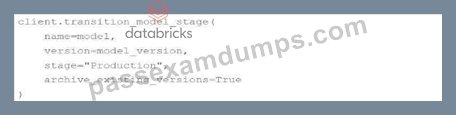
- B.
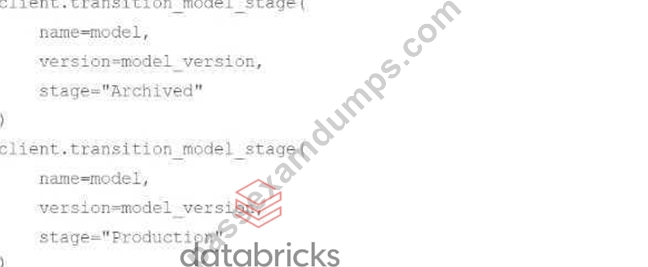
- C.
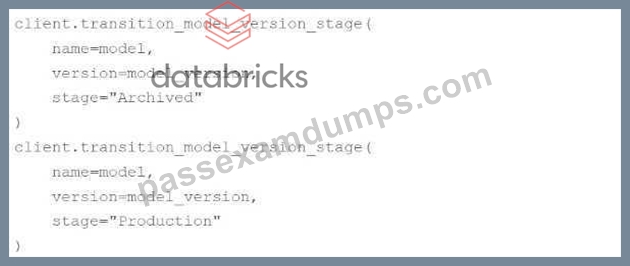
- D.

Answer: A
NEW QUESTION # 55
A Machine Learning Engineer is considering moving their functions and unit tests from notebooks into separate Python files (e.g., modules and test scripts) to take advantage of the numerous benefits of this approach like automated execution, code reusability, and version control. Which challenge should the engineer consider with this approach?
- A. Managing a more complex project structure can be harder to maintain and navigate.
- B. This change would prevent the use of any non-Python environments like Scala.
- C. It makes functions harder to import and reuse across different notebooks.
- D. Separating code and tests often leads to decreased reliability and poor code quality.
Answer: A
Explanation:
Moving code and unit tests into separate Python modules introduces a more structured project layout, which can increase complexity. Engineers must manage directories, dependencies, and imports carefully, making the project slightly harder to navigate and maintain compared to simple notebook-based workflows, especially for teams new to this structure.
NEW QUESTION # 56
A Machine Learning Engineer needs to deploy a custom model using Databricks Model Serving.
The model requires an external tokenizer file (for example, a vocabulary or pre-trained tokenizer) to function correctly. They need to ensure this tokenizer file is included with the model so it is available during model serving. How should they package this tokenizer file as part of the model deployment?
- A. Include tokenizer file as part of the model's software dependencies by adding it to the conda_env specification.
- B. Use the artifacts parameter in mlflow.pyfunc.log_model() to package the tokenizer file, referencing its path in Volumes.
- C. Access the tokenizer file directly from Volumes at model inference time, which requires pre- provisioning access to the Volume for every model serving endpoint.
- D. Use the code_paths parameter in mlflow.pyfunc.log_model() to include the tokenizer file, assuming it's part of the custom Python logic needed by the model.
Answer: B
Explanation:
The artifacts parameter in mlflow.pyfunc.log_model is designed for packaging non-code assets required at inference time, such as tokenizer files. By logging the tokenizer as a model artifact and referencing its path, MLflow ensures the file is versioned with the model and automatically made available to Databricks Model Serving during inference.
NEW QUESTION # 57
A Machine Learning Engineer uses Lakehouse Monitoring to track their credit scoring model's performance. The existing profile metrics table contains three aggregate metrics:
- adefault_risk_score
- payment_history_score
- credit_utilization_score
They need to:
1. Create a composite risk rating that combines these three scores using weights of 0.5, 0.3, and 0.2 respectively.
2. Monitor drift of this composite score against an established baseline.
Which approach should be used to implement both requirements within Lakehouse Monitoring?
- A. Create a derived metric for the composite_risk_rating calculation and create a drift metric on this derived metric.
- B. Create an aggregate metric for composite_risk_rating and configure a separate drift metric to monitor changes.
- C. Use a scheduled notebook to calculate the composite score and manually insert both the score and drift values into the profile metrics table.
- D. Create two separate aggregate metrics: one for the composite score calculation and another for drift detection.
Answer: A
Explanation:
Lakehouse Monitoring supports derived metrics that are computed from existing profile metrics using custom expressions. By defining a derived metric for the composite_risk_rating using the specified weights, the composite score becomes a first-class metric in the monitoring framework.
A drift metric can then be directly configured on this derived metric to compare current values against the baseline, fulfilling both the composite calculation and drift monitoring requirements in a native, governed way.
NEW QUESTION # 58
A machine learning engineer needs to deliver predictions of a machine learning model in real-time. However, the feature values needed for computing the predictions are available one week before the query time.
Which of the following is a benefit of using a batch serving deployment in this scenario rather than a real-time serving deployment where predictions are computed at query time?
- A. Testing is not possible in real-time serving deployments
- B. Querying stored predictions can be faster than computing predictions in real-time
- C. There is no advantage to using batch serving deployments over real-time serving deployments
- D. Computing predictions in real-time provides more up-to-date results
- E. Batch serving has built-in capabilities in Databricks Machine Learning
Answer: E
NEW QUESTION # 59
A machine learning engineer has developed the following custom model class with preprocessing logic to combine two columns: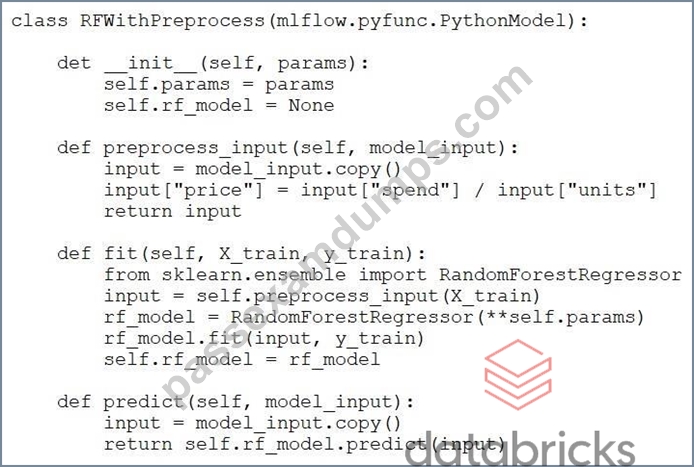
However, instances of this class are unable to compute predictions.
Which set of changes will update the class so predictions can be computed while continuing to apply the preprocessing logic?
- A. Remove the self.rf_model = rf_model line from the fit method
- B. Replace self.rf_model.predict(input) with self.predict(input) in the predict method
- C. Replace model_input.copy() with self.preprocess_input(model_input.copy()) in the preprocess_input method
- D. Replace model_input.copy() with self.preprocess_input(model_input.copy()) in the predict method
Answer: D
Explanation:
The issue is that the predict() method does not apply the same preprocessing as the fit() method.
During training, the model uses preprocessed data (via self.preprocess_input()), but during prediction, it directly uses raw input. This mismatch causes prediction errors because the model expects preprocessed input.
By updating the predict() method to call self.preprocess_input(model_input.copy()), both training and prediction use consistent feature transformations, allowing predictions to be computed successfully.
NEW QUESTION # 60
A machine learning engineer wants to move their model version model_version for the MLflow Model Registry model model from the Staging stage to the Production stage using MLflow Client client. At the same time, they would like to archive any model versions that are already in the Production stage.
Which of the following code blocks can they use to accomplish the task?
- A.
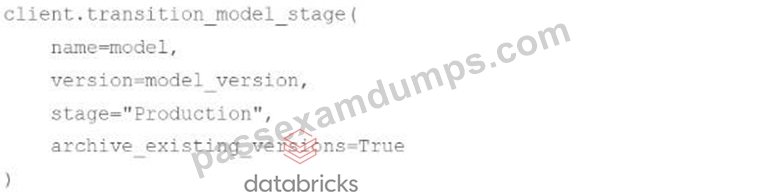
- B.
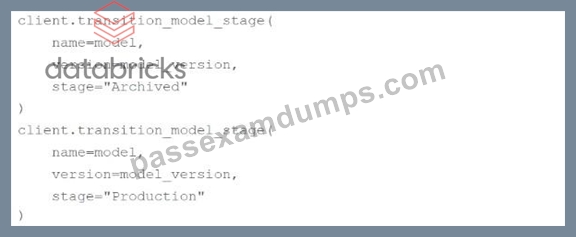
- C.
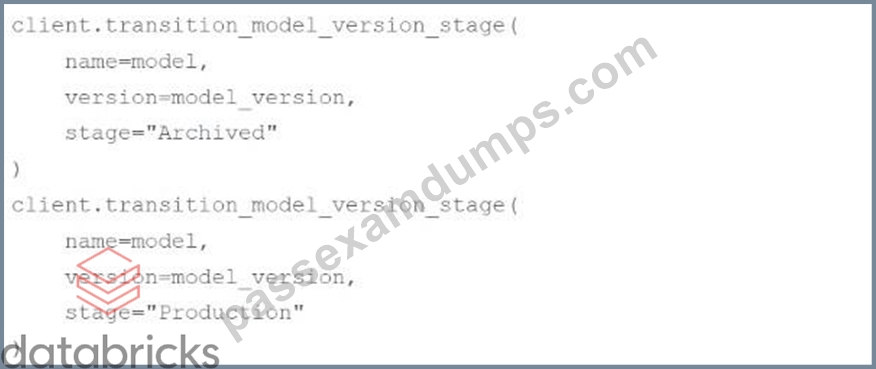
- D.
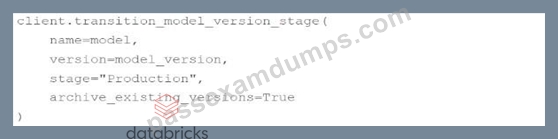
Answer: A
NEW QUESTION # 61
A machine learning engineer is manually refreshing a model in an existing machine learning pipeline. The pipeline uses the MLflow Model Registry model "project". The machine learning engineer would like to add a new version of the model to "project". Which MLflow operation can the machine learning engineer use to accomplish this task?
- A. mlflow.register_model
- B. The machine learning engineer needs to create an entirely new MLflow Model Registry model
- C. MlflowClient.update_registered_model
- D. MlflowClient.get_model_version
- E. mlflow.add_model_version
Answer: C
NEW QUESTION # 62
A machine learning engineer wants to deploy a model for real-time serving using MLflow Model Serving. For the model, the machine learning engineer currently has one model version in each of the stages in the MLflow Model Registry. The engineer wants to know which model versions can be queried once Model Serving is enabled for the model. Which of the following lists all of the MLflow Model Registry stages whose model versions are automatically deployed with Model Serving?
- A. Production
- B. Staging, Production, Archived
- C. None, Staging, Production, Archived
- D. None, Staging, Production
- E. Staging, Production
Answer: E
NEW QUESTION # 63
A Data Scientist is training a binary classification model using LogisticRegression in SparkML on a large dataset stored in a Delta table. After fitting the pipeline, they want to evaluate the model's performance using an appropriate metric and scalable method across the distributed test data using the SparkML API. Which model evaluation strategy will suit their needs?
- A. Use BinaryClassificationEvaluator with rawPredictionCo1 parameter, but first convert probability predictions to binary predictions using a UDF to ensure consistent evaluation across different Spark versions.
- B. Use the BinaryClassificationEvaluator on the transformed test DataFrame and specify the appropriate metric.
- C. Use MulticlassClassificationEvaluator with weightedPrecision metric since it provides more comprehensive evaluation than BinaryClassificationEvaluator for binary problems.
- D. Convert the DataFrame to RDD and use MulticlassMetrics.confusionMatrix() to calculate precision and recall manually, as this avoids the overhead of DataFrame operations in distributed environments.
Answer: B
Explanation:
BinaryClassificationEvaluator is the Spark ML-native, distributed evaluation API designed specifically for binary classification models. It operates directly on the transformed DataFrame produced by the pipeline and efficiently computes scalable metrics such as areaUnderROC or areaUnderPR without requiring data conversion or custom logic, making it the correct and efficient choice for large, distributed datasets.
NEW QUESTION # 64
A machine learning engineer and data scientist are working together to convert a batch deployment to an always-on streaming deployment. The machine learning engineer has expressed that rigorous data tests must be put in place as a part of their conversion to account for potential changes in data formats.
Which of the following describes why these types of data type tests and checks are particularly important for streaming deployments?
- A. None of these statements
- B. All of these statements
- C. Because the streaming deployment is always on, there is no practitioner to debug poor model performance
- D. Because the streaming deployment is always on, there is a need to confirm that the deployment can autoscale
- E. Because the streaming deployment is always on, all types of data must be handled without producing an error
Answer: D
NEW QUESTION # 65
A Data Scientist at a company with rapidly increasing sales has deployed a scikit-learn model in production, which is retrained weekly on a single-node cluster. During the most recent retraining, the job failed due to an out-of-memory error. Upon investigation, the Data Scientist discovered that the training data had increased to 700GB as a result of the company's expanding customer base. Which approach will reliably resolve this issue in the long term?
- A. Refactor the code to use the DeepSpeed library to shard the scikit-learn model across multiple nodes, enabling distributed model training on large volumes of data
- B. Wrap the current model training code as a Spark UDF and apply it to the Spark DataFrame to distribute model training across multiple nodes.
- C. Refactor the code to use MLlib across multiple nodes, enabling distributed model training on large volumes of data
- D. Increase the size of the current single-node cluster to handle the increase of data while minimizing the need for code refactoring
Answer: C
Explanation:
Spark MLlib is designed for distributed model training on large-scale datasets and can natively handle hundreds of gigabytes of data across multiple nodes. Refactoring to MLlib enables the training workload to scale with data growth, avoids single-node memory limitations, and provides a reliable long-term solution as the company's data continues to expand.
NEW QUESTION # 66
A machine learning engineer wants to move their model version model_version for the MLflow Model Registry model model from the Staging stage to the Production stage using MLflow Client client. Which of the following code blocks can they use to accomplish the task?
- A.
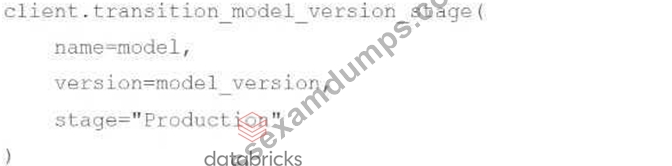
- B.

- C.

- D.
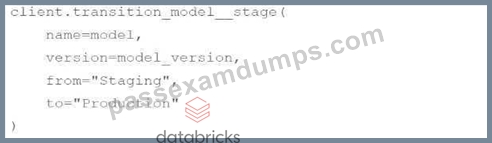
- E.
Answer: B
NEW QUESTION # 67
A Machine Learning Engineer wants to deploy a new change to their existing model training pipeline for a social media app. Currently, they use the Databricks Feature Store to create a training set to train their LightGBM model, which is then used in a Pandas UDF for batch inference to suggest potential friends to users. They have updated the feature engineering pipeline to include an additional feature function, which now computes the number of mutual friends a user has. Which test should they add to quickly inform them if something has broken in the test environment?
- A. Add a unit test that verifies the new mutual friends feature function correctly calculates expected values on a fake dataset.
- B. Implement an integration test that runs the feature engineering pipeline in the production environment.
- C. Implement an integration test that runs the entire pipeline from feature engineering to model inference in the production environment.
- D. Add a unit test that verifies the new mutual friends feature function correctly calculates expected values on live data.
Answer: A
Explanation:
A unit test targeting the new feature function provides the fastest and most reliable signal that the recent change behaves correctly. By validating the mutual friends calculation on a controlled, fake dataset in the test environment, the engineer can quickly detect logic errors without the cost, risk, or latency of running full pipeline or production-based tests.
NEW QUESTION # 68
A Machine Learning Engineer is responsible for maintaining a fraud detection model deployed on Databricks. They want to implement a retraining pipeline that automatically starts when the model's F1 score drops below a threshold or when input feature distributions change significantly.
Which two actions should the engineer take to implement this automated retraining? (Choose two.)
- A. Use Databricks SQL to create alerts on model performance and data drift metrics stored in Delta tables.
- B. Configure these alerts to send webhook notifications that trigger the model training job.
- C. Use MLflow to manually log metrics and retrain the model offline.
- D. Schedule a recurring query on the Lakehouse monitoring table.
- E. Set up a manual retraining schedule to run every week regardless of alerts.
Answer: A,B
Explanation:
Databricks Lakehouse Monitoring stores model performance and data drift metrics in Delta tables, which can be monitored using Databricks SQL alerts. By creating alerts on F1 score degradation or significant feature drift and configuring those alerts to send webhook notifications, the engineer can automatically trigger a retraining job whenever predefined conditions are met, enabling event-driven, automated retraining aligned with MLOps best practices.
NEW QUESTION # 69
......
Free Databricks-Machine-Learning-Professional braindumps download: https://www.passexamdumps.com/Databricks-Machine-Learning-Professional-valid-exam-dumps.html
Databricks-Machine-Learning-Professional Dumps 2026 - NewDatabricks Exam Questions: https://drive.google.com/open?id=1DrBkQBIYxQAfczhk5UUnXqRRc0qaCqZH
