

Latest 300-510 Exam Dumps Cisco Exam from Training Expert PassExamDumps
Pass Cisco Implementing Cisco Service Provider Advanced Routing Solutions PDF Dumps | Recently Updated 304 Questions
Cisco 300-510 certification exam is ideal for network engineers, network administrators, network designers, and technical support personnel who work in a service provider environment. 300-510 exam tests the candidates' ability to configure, implement, and troubleshoot various routing protocols and services, including OSPF, IS-IS, BGP, MPLS, Layer 3 VPNs, and multicast routing. 300-510 exam also covers topics such as routing policy and route manipulation, as well as high availability and network security.
Cisco 300-510 exam covers a wide range of advanced routing technologies, including Border Gateway Protocol (BGP), Multiprotocol Label Switching (MPLS), and Virtual Private Network (VPN) technologies. It also tests the candidate's knowledge of advanced routing policies, route redistribution, and route filtering techniques. Successful candidates are expected to have a deep understanding of how these technologies work and how they can be configured and optimized in a service provider network.
NEW QUESTION # 85
Refer to the exhibit. A network operators configuring BGP PIC on CE1 on already established neighborships with PE1ana PE2 inside the fully converged MPLS network.
Which element needs to be implemented to make this feature function effectively?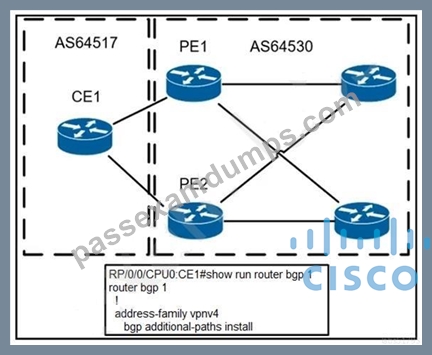
- A. BGP import export policies must be applied on all devices for the routes needing BGP for PIC
- B. The operator must ensure that all prefixes have the same next-hop from PE1 and PE2 for BGP PICA reserved BGP
- C. community of 1 10 must be used to denote the PIC feature set to the routing protocol
- D. Bidirectional Forwarding Detection must be applied to the upstream facing BGP interfaces.
Answer: D
NEW QUESTION # 86
SIMULATION
Guidelines
This is a lab item in which tasks will be performed on virtual devices.
- Refer to the Tasks tab to view the tasks for this lab item.
- Refer to the Topology tab to access the device console(s) and perform the tasks.
- Console access is available for all required devices by clicking the device icon or using the tab(s) above the console window.
- All necessary preconfigurations have been applied.
- Do not change the enable password or hostname for any device.
- Save your configurations to NVRAM before moving to the next item.
- Click Next at the bottom of the screen to submit this lab and move to the next question.
- When Next is clicked, the lab closes and cannot be reopened.
Topology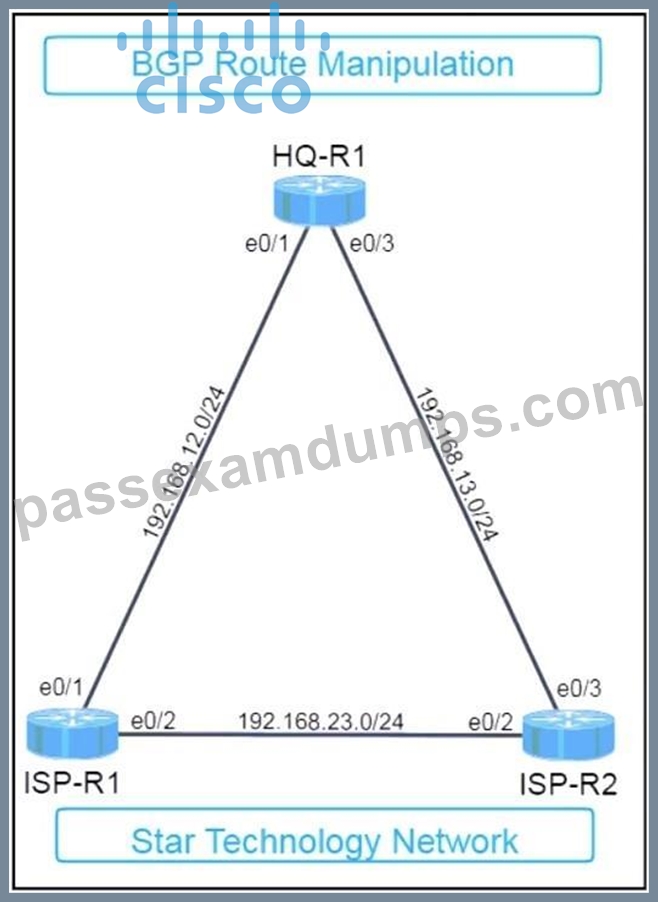
Tasks
Star Technology has decided to establish connectivity with an ISP for accessing the Internet. In phase 1, the approach is to establish a dual-homed connection from HQ-R1 to ISP-R1 and ISP- R2. This will provide some degree of redundancy in the connectivity between HQ-R1 and ISP routers.
Based on network design, an autonomous system of Star Technology is 1, and AS of ISP is 2. A network Implementation Engineer has already initiated the configuration; trouble-shooting is required to find out and complete missing configurations. Moreover, configuration is to be established in a way that links between HQ-R1 and ISP-R1 can be used as the preferred path for reaching AS 2.
Below are tasks to be achieved to include the missing commands and complete the troubleshooting Task 1:
On HQ-R1, configure BGP for Autonomous System 1. Establish EBGP relationship with ISP-R1 and ISP-R2.
Notes:
After performing troubleshooting at HQ-R1, the following outcome should appear.
%BGP-5-ADJCHANGE: neighbor 192.168.12.2 Up
%BGP-5-ADJCHANGE: neighbor 192.168.13.2 Up
Task 2:
On HQ-R1, Advertise LBO interface as a prefix in BGR
Task 3:
On HQ-R1, configure the route map with the name loc. Set the local preference attribute as 900.
Task 4:
On HQ-R1, define the path between HQ-R1 - ISP-R1 as the preferred path for reaching AS 2.
Route map configured in task 3 to be used in the inbound direction.
Answer:
Explanation:
Task 1: Configure BGP for AS 1 and Establish EBGP Peering with ISP-R1 and ISP-R2 To establish an EBGP relationship between HQ-R1 and ISP-R1/ISP-R2 on HQ-R1:
router bgp 1
neighbor 192.168.12.2 remote-as 2
neighbor 192.168.13.2 remote-as 2
router bgp 1: Enables BGP for AS 1 on HQ-R1.
neighbor <IP> remote-as 2: Establishes an EBGP session with the neighbors ISP-R1 (192.168.12.2) and ISP-R2 (192.168.13.2).
Task 2: Advertise Loopback0 Interface Prefix in BGP
To advertise the loopback interface (e.g., Loopback0) into BGP on HQ-R1:
router bgp 1
network <L0 IP> mask <L0 Subnet>
Example (assuming Loopback0 IP is 192.168.10.1/24):
router bgp 1
network 192.168.10.0 mask 255.255.255.0
The networkcommand specifies which prefix (L0) to advertise into BGP.
Task 3: Configure a Route Map Named locto Set Local Preference to 900
To set the local preference attribute to 900 using a route map on HQ-R1:
route-map loc permit 10
set local-preference 900
route-map loc permit 10: Creates a route map named loc.
set local-preference 900: Sets the local preference to 900, which influences route selection.
Task 4: Prefer the Path via ISP-R1 for Reaching AS 2
To prefer the link between HQ-R1 and ISP-R1 as the preferred path on HQ-R1:
router bgp 1
neighbor 192.168.12.2 route-map loc in
neighbor 192.168.12.2 route-map loc in: Applies the locroute map inbound on the session with ISP-R1 (192.168.12.2).
This sets the local preference to 900 for routes received from ISP-R1, making it the preferred path.
Verification Commands
Verify BGP Neighbors: show ip bgp summary
Expected output: Neighbors 192.168.12.2and 192.168.13.2should be Up.
Verify Advertised Routes: show ip bgp
Confirm the Loopback0 prefix is advertised.
Verify Local Preference: show ip bgp neighbors 192.168.12.2 received-routes
Check that the local preference is 900 for routes from ISP-R1.
Complete Configuration Summary on HQ-R1:
router bgp 1
neighbor 192.168.12.2 remote-as 2
neighbor 192.168.13.2 remote-as 2
network 192.168.10.0 mask 255.255.255.0
neighbor 192.168.12.2 route-map loc in
route-map loc permit 10
set local-preference 900
The local preference value of 900 ensures that routes from ISP-R1 are preferred over ISP-R2.
The Loopback0 prefix is successfully advertised into BGP.
The BGP sessions to ISP-R1 and ISP-R2 are established as required.
NEW QUESTION # 87
Refer to the exhibit.
A network engineer applied configuration on R1 to summarize all ISIS routes, but R2 Is still receiving specific routes from R1. The engineer has confirmed that both routers are configured with the correct summarization configuration, but R1 is not sending the correct summary routes. Which configuration must be applied to router R1 to summarize routes within Level 1?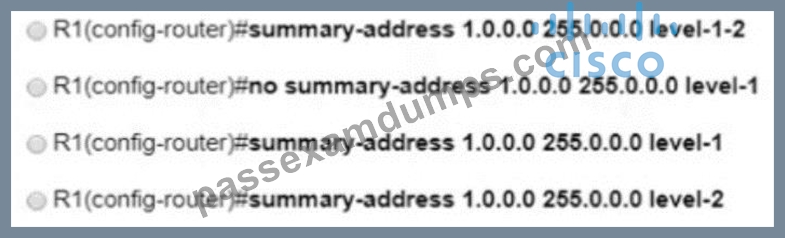
- A. Option D
- B. Option B
- C. Option A
- D. Option C
Answer: D
NEW QUESTION # 88
Refer to the exhibit.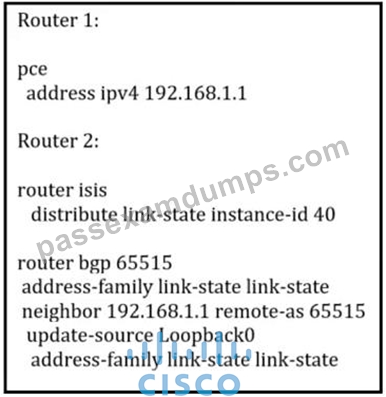
What is the relationship between Router 1 and Router 2?
- A. Router 1 and Router 2 centrally learn the topology of the network to aid in SR-TE path selection for peers.
- B. Router 2 is the head-end router in an SR-TE tunnel, and it is learning topology of the network from the PCE enabled on Router 1.
- C. Router 1 and Router 2 are participating in SR-TE tunnels and are both head-end routers.
- D. Router 1 centrally learns the topology of the network to aid in SR-TE path selection, and Router 2 is a node that feeds Router 1 topology information.
Answer: B
NEW QUESTION # 89 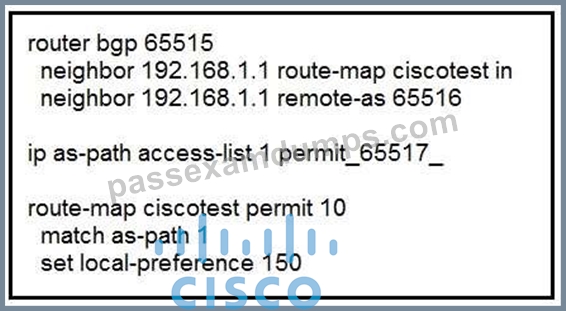
Refer to the exhibit. After troubleshooting BGP traffic steering issue, which action did the network operator take to achieve the correct effect of this configuration?
- A. Routes that have passed through AS 65517 have the local preference set to 150.
- B. Routes directly attached to AS 65517 have the local preference set to 150.
- C. Routes that have originated through AS 65517 have the local preference set to 150.
- D. Routes that have passed through AS 65517 have the local preference set to 150 and the traffic is denied.
Answer: A
NEW QUESTION # 90
Refer to the exhibit.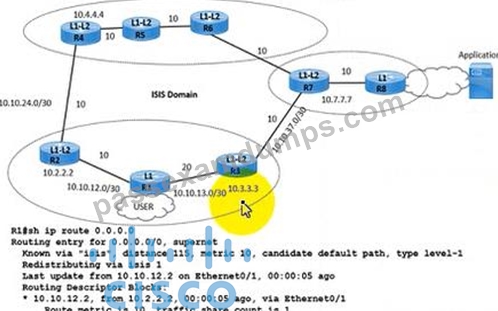
Refer to the exhibit An engineer is troubleshooting a networking issue with several symptoms The shortest path from router R1 to R8 is underused and the longest path is overused Traffic from 10.1.1 1 to 10 8 8 8 is routed on the longest path Traffic between the R1 and the application server is experiencing packet drops and latency problems.
Which action resolves the issue?
- A. Configure a Level 2 IS-IS domain on router RI.
- B. Increase the RI to R2 link metric to 20.
- C. Block the advertisement of the application server IP address to router R6.
- D. Configure route leaking for the IP address Of the application server on router RI.
Answer: A
NEW QUESTION # 91
Refer to the exhibit.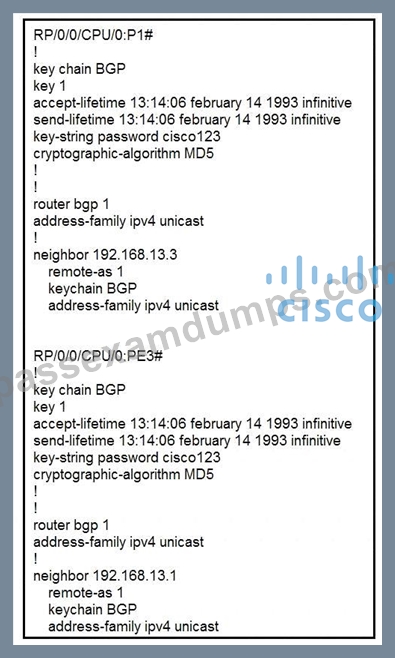
P1 and PE3 Cisco IOS XR routers are directly connected and have this configuration applied. The BGP session is not coming up. Assume that there is no IP reachability problem and both routers can open tcp port 179 to each other. Which two actions fix the issue? (Choose two.)
- A. Change MD5 to HMAC-SHA1-12
- B. Remove the send and accept lifetime under key 1
- C. Change MD5 to HMAC-MD5
- D. Change MD5 to SHA-1
- E. Change MD5 to HMAC-ESP
Answer: A,C
NEW QUESTION # 92
What does conditional matching operate with RPL?
- A. The matching identifies interfaces that run the same routing protocol and manipulates data based on the routing rules
- B. The matching identifies a set of criteria, and an action is taken based on whether the criteria are the same or different
- C. The matching identifies tags that are placed on routes from neighboring autonomous systems and drops the routes if they are the same.
- D. The matching identifies a group of routes that are removed from the routing table when the administrator defined tags match
Answer: B
NEW QUESTION # 93
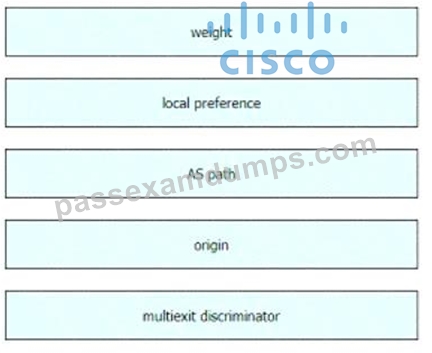
Drag and drop the BGP attributes from the left into the order of route selection preference on the right.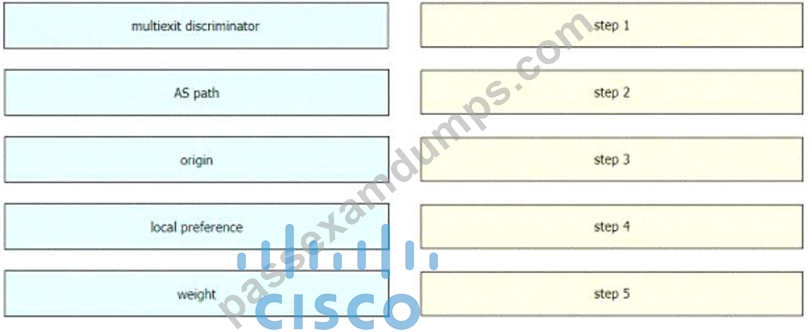
Answer:
Explanation: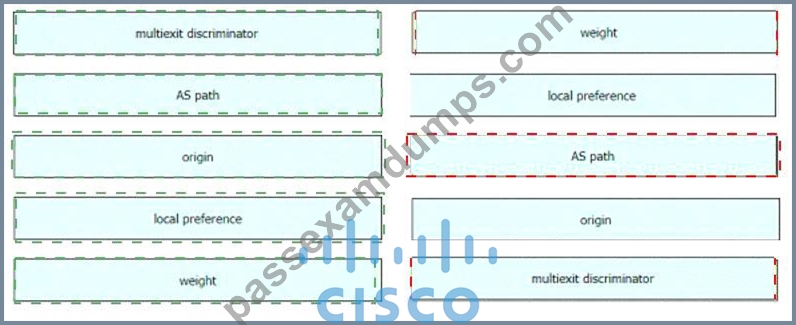
NEW QUESTION # 94
Refer to the exhibit.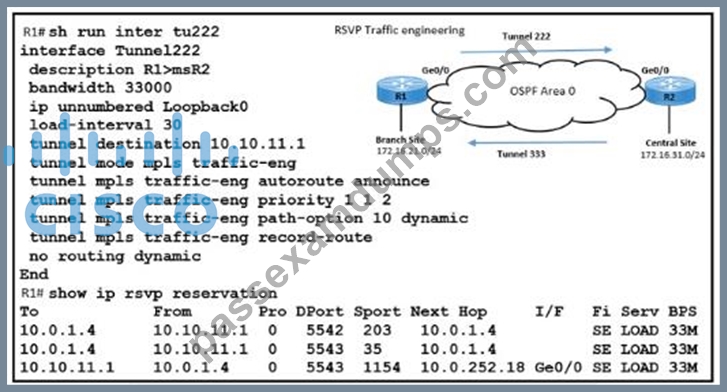
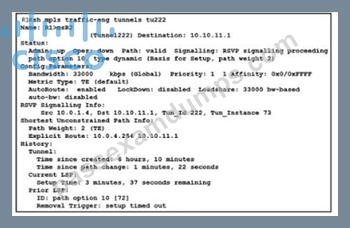
Refer to the exhibit. A network engineer is investigating a report of packet drops between the branch site and the central site.
The two sites are connected via OSPF and RSVP-TE tunnels.
Traffic from the central site to the branch site is passing normally.
Technicians at both sites successfully ping the loopback IP addresses on routers R1 and R2.
Which configuration corrects the packet-drop problem?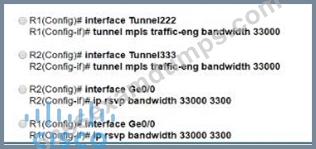
- A. Option C
- B. Option B
- C. Option A
- D. Option D
Answer: D
NEW QUESTION # 95
Refer to the exhibit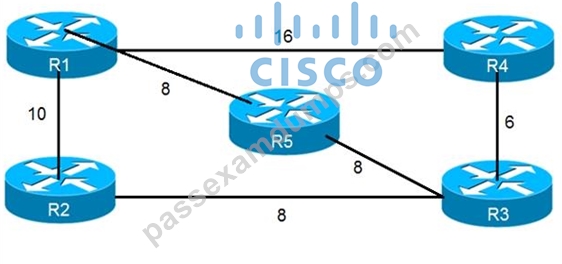
Which router does R1 install as an alternate next hop when trying to reach R3 if LFA is enabled?
- A. R5
- B. R3
- C. R4
- D. R2
Answer: D
NEW QUESTION # 96
Refer to the exhibit.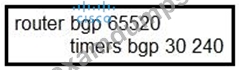
Which effect of this configuration is true?
- A. It sets the hold timer to 30 seconds and the keepalive timer to 240 seconds
- B. It sets the keepalive timer to 30 milliseconds and the hold timer to 240 milliseconds
- C. It sets the hold timer to 30 milliseconds and the keepalive timer to 240 milliseconds
- D. It sets the keepalive timer to 30 seconds and the hold timer to 240 seconds.
Answer: D
Explanation:
Reference:
html#wp1552800140
NEW QUESTION # 97
Refer to the exhibit.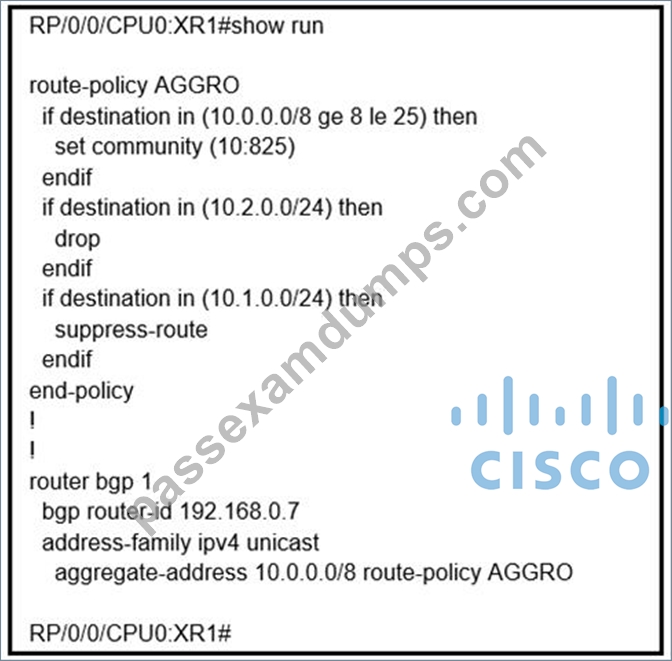
A network operator is working to filter routes from being advertised that are covered under an aggregate announcement. The receiving router of the aggregate announcement block is still getting some of the more specific routes plus the aggregate. Which configuration change ensures that only the aggregate is announced now and in the future if other networks are to be added?
- A. Filter the routes on the receiving router
- B. Set each specific route in the AGGRO policy to remove instead of suppress-route
- C. Set each specific route in the AGGRO policy to drop instead of suppress-route
- D. Configure the summary-only keyword on the aggregate command
Answer: D
NEW QUESTION # 98
What is the difference between basic IS-IS and OSPF packet types?
- A. IS-IS and OSPF use link-state update packets, but only OSPF uses link-state ACK packets.
- B. IS-IS and OSPF use area packets, but only IS-IS uses sequence number packets.
- C. IS-IS and OSPF use link-state update packets, but only IS-IS uses DBD packets.
- D. IS-IS and OSPF use Hello packets, but only OSPF uses DBD packets.
Answer: D
NEW QUESTION # 99
What is one of the purposes of a default Multicast Distribution Tree?
- A. to define the RP for PIM sparse mode and the different leafs
- B. to support control traffic between different VRFs
- C. to offload traffic from data MDT
- D. to handle high-bandwidth source streams
Answer: B
NEW QUESTION # 100
......
Updated Test Engine to Practice 300-510 Dumps & Practice Exam: https://www.passexamdumps.com/300-510-valid-exam-dumps.html
Dumps Collection 300-510 Test Engine Dumps Training With 304 Questions: https://drive.google.com/open?id=16rYYAa-W01HvsweE7cX75Lqf7D38bWic
